The so-called "controversy" between those who want Intelligent Design to be taught in biology class and those who want science and not religious dogma to be taught, is not unrelated to the brewing war of words over the threat of Global Warming. Some of the same groups who want the Bible taught alongside Darwin are probably also aligned with those who downplay or deny the phenomenon called Global Warming. This is not surprising. Both Darwin's theory of evolution and the theory of Global Warming involve virtually imperceptible changes to our natural habitat over a protracted period of time. As Darwin observed in his
Origin of Species, "so imperfect is our view into long past geological ages, that we only see that the forms of life are now different from what they formerly were." However, the key difference between evolution and climate change is that the former is a natural process over which humans have very little influence, whereas the latter is a troublesome reality precisely because we have no one to blame but ourselves for the changes we have wrought on nature. Among scientists, there is no disagreement that increased concentrations of carbon dioxide in the atmosphere means higher temperatures. Like evolution, Global Warming is not a speculative theory, but a verified reality. The question, however, is whether
politicians should take this reality seriously.
That the climate has changed, just as species have evolved, is all too evident. This is not news. Nor is it news that humans have altered the earth's atmosphere. What is news is that we can no longer watch reports about Global Warming as merely news, but must do something, must
really do something significant, and quickly, before the earth is rendered "inhospitable" to human life,
as Bill McKibben continues to warn.
During the last half of the twentieth century, a period characterized by the Cold War, the fear was that the human race would destroy itself directly through a nuclear war or indirectly as a result of the damage such a war would inflict on our environment. This threat remains. We still live in a nuclear age stalked by the threat of nuclear extermination, as Jonathan Schell, author of
The Unfinished Twentieth Century, and Robert S. McNamara, former U.S. Secretary of Defense, continue to warn. But the fear of nuclear annihilation has been eclipsed in the public imagination by the fear of Global Warming, the new favorite topic of prophetical fearmongers.
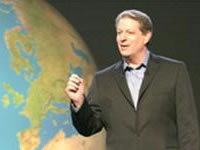
A case in point is Al Gore’s new movie, "An Inconvenient Truth." Unfortunately, it has already created more buzz about
Al Gore’s non-existent ambitions to be president than about the "Truth" of its title. As the title indicates, and as Al Gore has insisted repeatedly, the film is a vehicle of Gore the Professor, not Gore the would- and should-be president. Its goal is a moral one: to bring to light inconvenient facts -- inconvenient, that is, for Party platforms. This movie is very much the creation of a man who has made teaching his new vocation. And it will be Gore’s moral achievement if the audience of his movie should come to accustom themselves with the facts, and demand real action from politicians.
I haven't seen the movie, but I’ve read that Gore, like McKibben, suggests that Global Warming, in the not so distant future, may make the world unfit for human habitation. This is an unproductive digression from the inconvenient truth: an attempt not to persuade people to love the environment but to make people fear inaction on the issue. Resort to fear here is an act of desperation, a political weapon in defense of an all but lost cause. This is not a productive way forward, for it provides the opportunity for politicians to appear active by claiming credit for token legislation that fails to change the facts. Our environment will only be adequately protected once it becomes the object of our love, guarded with jealously against those who would despoil it. Until then, let us hope that the apocalyptic fearmongers are wrong. I'm afraid that we believe our hopes more than our fears, and that while we may fear the worse, we will commit to action only on the basis of our hopes for the future.