Showing posts with label Foreign Policy. Show all posts
Showing posts with label Foreign Policy. Show all posts
Friday, November 07, 2008


Tuesday, July 15, 2008
Should We Stay or Should We Go?
That's the central question regarding our policy in Iraq and should be one of the main questions dominating the news cycle. In my view, the Iraqis have answered it for us, they have asked to sit down and establish a timeline for withdrawal. If in fact the objective is to establish a sovereign state, then we should respect that state's sovereignty. Time to go home.
Sunday, October 21, 2007
Foreign Aid Tax Credit
Here's an op-ed proposing a tax credit for corporations that invest in developing nations. This idea seems really impractical from a political standpoint as it reeks of corporate welfare and is likely to really piss of the Lou Dobbs/nativist crowd. That said, it looks like an upgrade over a lot of our direct foreign aid, sadly.
Wednesday, October 17, 2007
Tuesday, October 16, 2007
The Armenian Genocide Vote...
Is one of the stupider things that Congress (mostly Democrats but a good number of Republicans are joining in on the fun) could be doing right now. I guess, to the extent that one holds out hope for Iraq, pissing off the Turks doesn't really seem to be a good idea. I am not denying the Armenian Genocide, nor do I think it is good that Turkey denies it. I just sorta think we don't have all that many friends in that part of the world and Turkey is one, one that we need and are currently relying on not to mess up our shit even further. Maybe that's something we don't need to disturb at this point.
Tuesday, October 09, 2007
Candidates' Foreign Policy Advisors
The Post has a wrap-up of the presidential candidates' foreign policy advisors. McCain's list is positively schizophrenic. It features the who's who of the GOP war caucus and the most prominent GOP critics of the Bush administration's foreign policy.
Thursday, October 04, 2007
DipShit, er, Note
The State Department is getting not quite savvy on the whole blogging thing. They now have a blog called Dipnotes.
Tuesday, October 02, 2007
Surge Working?
The Boston Herald has a bit of positive news on Iraq:
Reihan Salam asks if conservative commentators are correct that the surge is working. First one must ask what the purpose of the surge was? It was to provide security and stability (breathing room if you will) for an Iraqi political reconciliation to work. I see no evidence of such a reconciliation occurring. I think what the surge has allowed is for a less violent partitioning of Iraq. If we are to stay in Iraq policy makers must disabuse themselves of the notion of "Iraq". Sens. Brownback and Biden are the only ones thus far to present this concept. Brownback was ridiculed for it and Biden has not gained any real political support from it either, though it has not been harmful as the Democratic caucus is decidedly more sane these days.
Friday, September 28, 2007
Pipe Dream
I was reading a bit over at the Financial Times about a global warming conference Bush summoned with all of the other big polluters (side note: in German the word for polluter is umweltverschmutzer, which amounts literally to something like earth dirty maker). Bush seems to have transitioned from the earth ain't warming, to the earth is warming but it is unclear what the causes are, to ok, the science is settled. Now I don't think there is much likelihood Bush will actually do anything substantive (like a revenue neutral carbon tax) other than maybe propose another alternative energy R&D tax credit or a tax deduction for purchasing a energy efficient domestically produced washers or other electronic appliances (maybe Maytag is a political contributor to the bushes). But I think maybe there is a chance that he would like to leave office with some warm fuzzies and after the unmitigated disaster that this administration has been (read: Iraq, Katrina, Gonzalez, etc.), something like climate change would allow for a bold bipartisan action to put a prettier patina on Bush's legacy. That said, I am not holding my breath.
Tuesday, September 25, 2007
Bhutto Returns to Pakistan
Don't know exactly what this means but it seems to be a victory for the State department in the ongoing (dare I say eternal) turf war between State and Pentagon. Not knowing much about her rule except anecdotal info from some Pakistani friends is that she sucked, just in a different if not better or worse way than Musharraf.
Sarkozy on Iran
Sarkozy has been talking tough on Iran which is out of character for European heads of state who are usually keen on playing the part of good cop to our bad cop in foreign policy when they agree with American foreign policy makers. It will be interesting to see how this develops. Pres. Bush went to war in spite of the vehement opposition of much of the world, what happens when a France is supportive and Germany mum on the issue?
Thursday, September 20, 2007
Building on Ilya's Thoughts
Ilya is correct, the concept of Iraq is a fiction. The only compelling rationale for being there at this point is to referee the partitioning of Iraq. In Mickey Kaus' terminology to keep it as a "small hell" as opposed to a "big hell".
Envisaging Reality in Iraq
I haven't posted in a while - but this description of life in Iraq is just too arresting. It says it all. It's from the journalist Nir Rosen, who has been doing excellent work reporting on this mess. Check out his blog.
"Iraq" is a fiction; what exists are bands of petty countries, each fighting for dominance.
"The only way to avoid being seized by one of the many militias that terrorize Iraq is to travel with your own militia."
"Iraq" is a fiction; what exists are bands of petty countries, each fighting for dominance.
Tuesday, September 18, 2007
Interesting Development
Iraq has banned the Blackwater Security Company. Blackwater, like other private security firms, are not held to any of the particulars that order combat conducted by the military. So in essence they can shoot first and ask questions later. Part of the U.S. military strategy has been to lean on these firms so that the Administration can limit its political exposure by not having as many troops on the ground. Even with this backdoor troop augmentation there have clearly been an inadequate number of troops to stabilize the country. I think this will exacerbate matters. That said, it does show that the Iraqi government is showing some autonomy. Whatever, it's all a mess.
Tuesday, September 11, 2007
John Robb on Iraq
Robb has a good blog post on why we will, not should, but will stay in Iraq and Afghanistan for some time to come.
He lists three core reasons, the last of which intrigues me especially:
1. Superior Marketing
2. The elasticity of the conflict (i.e. the notion of a war on terror)
3. privatization of the conflict.
I don't know to what extent the last one actually explains the current acceptance or reluctance to alter the status quo. Clearly the lives lost have been far too many (one being too many). That said, in terms of historical norms of armed combat, Iraq casualties are strikingly few. That said Blackwater and security firms of the like do lose men in combat (under contract) and this does not figure into public calculus.
hat tip: Ross Douthat
He lists three core reasons, the last of which intrigues me especially:
1. Superior Marketing
2. The elasticity of the conflict (i.e. the notion of a war on terror)
3. privatization of the conflict.
I don't know to what extent the last one actually explains the current acceptance or reluctance to alter the status quo. Clearly the lives lost have been far too many (one being too many). That said, in terms of historical norms of armed combat, Iraq casualties are strikingly few. That said Blackwater and security firms of the like do lose men in combat (under contract) and this does not figure into public calculus.
hat tip: Ross Douthat
Thursday, August 23, 2007
Sliding Towards Hanoi
Bush gave a speech yesterday at a VFW in St. Louis. In the speech he spoke of the withdrawal from Vietnam and the devastation that ensued to the Vietnamese and Cambodians and to America's image (both moral and its ability to project power). I think one can draw this Analogy between Vietnam and Iraq, but it is ironic that the President would do so because the reason that this aspect of the analogy is apt is that all other aspects of the analogy are apt as well.
Thursday, January 11, 2007
The Show Must Go On!
Last night we heard from Mr. Bush that it is important to keep the present horror show playing out in Iraq on the road. After having acknowledge that the territory that was Iraq is now a deeply divided and violent place where "outrageous acts of murder" recur daily, he spent the bulk of his speech speaking as if this is merely the product of a lapse in "strategy" on our part, and not a further confirmation of what we all know to be the case, namely that the sterility of troops in the effort to "stabilize" Iraq has been proven many times over. The greatest evil Mr. Bush can conjure up is a rogue regime in Iraq, intent on killing Americans. By invading Iraq and deposing Saddam Hussein, Mr. Bush believes he courageously and heroically removed one such regime. But his solution has become the problem. Or rather, he never had a solution for how Iraq would be governed without Saddam. And he continues to use the mortal terror that has gripped Iraq in the wake of America's invasion and occupation as an excuse to deploy more violence with the hope that once Baghdad and the rest of Iraq has been "clear and secure," Iraqis will finally come together as a plural yet united nation. Yet how can this hope can be squared with the known conditions of Iraq? "Americans know," the Times editorial notes, "that this Iraqi government is captive to Shiite militias, with no interest in the unity, reconciliation and democracy that Mr. Bush says he wants." Hence it is that the problem in Iraq is more fundamental than security and reconciliation, it is about the integrity of the state of Iraq, about how it will run. Telling it to run a different way simply begs the question and ignores the way it is already being run.
Mr. Bush is under the illusion that Iraq is basically good, except for the bad elements which can be purged and cleared with more troops. This misbegotten belief in the cleansing act of violence only points in one direction: overkill. "Rationalistic metaphors about cleaning," as William T. Vollmann writes in Rising Up, Rising Down, his massive study of violence, suggest "processes which require overkill for their effectiveness to be guaranteed." Hence the problem with Bush's "surge" of troops is not only that it will fail, but that from the get-go it stops well short of the numbers that would be required to impose an effective police state in Iraq. As the Times says, "There is nothing ahead but even greater disaster in Iraq."
Mr. Bush is under the illusion that Iraq is basically good, except for the bad elements which can be purged and cleared with more troops. This misbegotten belief in the cleansing act of violence only points in one direction: overkill. "Rationalistic metaphors about cleaning," as William T. Vollmann writes in Rising Up, Rising Down, his massive study of violence, suggest "processes which require overkill for their effectiveness to be guaranteed." Hence the problem with Bush's "surge" of troops is not only that it will fail, but that from the get-go it stops well short of the numbers that would be required to impose an effective police state in Iraq. As the Times says, "There is nothing ahead but even greater disaster in Iraq."
Monday, November 06, 2006
Hang Him High
 It was announced yesterday that Saddam Hussein was convicted of crimes against humanity and sentenced to death by hanging.
Does anyone else find the timing of the announcement rather convenient? Since when does any court release their verdict and sentences on a Sunday, unless of course it is the Sunday before a congressional election where any good news out of Iraq could help Republicans. Maybe releasing the news the day before the election just seemed far too obvious, plus that wouldn’t give the president enough time to utilize the announcement for political purposes.
I think that Riverbend, author of the blog Baghdad Burning, summed up the situation the best.
The most ironic part of the ruling is that the crimes that Saddam was convicted of actually took place one year before the famous meeting of Saddam Hussein and Donald Rumsfeld.
Friday, October 13, 2006
Bush: A Failure In Diplomacy & Leadership
 As I am sure everyone is aware earlier this week North Korea announced that they had successfully tested a nuclear devise. So now one of the craziest and by far the sexiest dictator in the world has nuclear weapons at his disposal. So what does all of this mean?
Well as far as the future goes I don’t think anybody, not even the pundits on the 24-hour news channels, have any idea. But all one has to do is look back at the policy of the Bush administration in relation to North Korea and see that it all adds up to one giant diplomatic failure and a complete inability on the part of President Bush to actually act as a leader.
Now I realize that when something goes bad for the Bush administration and Republicans the first thing they do is immediately blame everything on policies implemented during the Clinton administration. And that is exactly what happened; take for instance what Sen. John McCain said earlier this week during a speech in Detroit. McCain stated:
“I would remind Senator Hillary Rodham Clinton and other critics of the Bush administration policies that the Framework Agreement of the Clinton administration was a failure.”
Now for those of you not familiar with the Framework Agreement, this was an agreement reached through direct negotiations between the Clinton administration and North Korea. The agreement came after a very dire threat of war in 1994 and it froze North Korea’s entire plutonium facility at Yongbyon. There were seals on the doors, closed-circuit televisions, and at least two UN inspectors on the ground, 24/7, all the time. This agreement held from 1994 until 2002 and denied North Korea the plutonium that would have allowed them to make more bombs.
Now if one simply wants to look at this agreement and nothing else then it would be very easy to say that the policy failed since in 2002 North Korea purchased nuclear technology from America’s ally and close partner in the so called “war on terror” Pakistan, broke the terms of the Framework Agreement and restarted there nuclear program.
But to simply look at the breakdown of the agreement outside of the broader Bush foreign policy would be completely naïve. So what happened in 2002 that could have had an impact on North Korea’s decision to violate the Framework Agreement?
In January of 2002 in Bush’s State of the Union address he famously referred to North Korea as one part of the "axis of evil", Bush announced his policy of preemption, and under the policy of preemption we illegally invaded Iraq. And in response to these actions North Korea made the decision that America would not take action against a nuclear power, the reason why we invaded the weakest of the three so called "evil" nations first, and thus North Korea resumed their nuclear program. Couple this with the fact that since coming into office, President Bush, unlike his predecessor, has refused repeated overtures by Kim Jong Il to open direct talks, insisting that all negotiations with North Korea occur within a 6-party framework.
So basically the Bush administration’s arrogance, stubbornness and complete lack of diplomatic tact is one of the major causes of North Korea’s rise to a nuclear power. And history will now forever record President Bush’s legacy as being the sitting American president who allowed North Korea to become the world’s ninth, yes ninth because unlike everyone in the corporate media I am not forgetting about Israel, nuclear power.
I would also like to take this time to thank all of the unwavering, flag flying Bush supporters out there. Thanks to your collective ignorance and steadfast fear that around every corner lurks some phantom terrorist ready to kill you, the world is now neck deep in the worst nuclear crisis since the Cold War.
To all of you brainwashed Bushites, I would like to thank you from the bottom of my heart, you may have just f*cked us all.
Tuesday, August 15, 2006
Professor Ahmadinejad
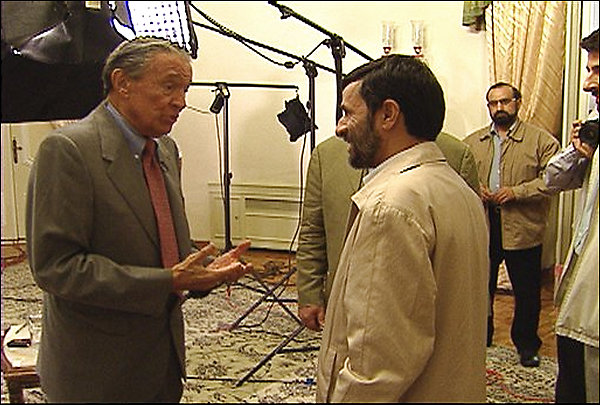 “Thus you will see how from a silly question many wise answers can be produced, and such is probably the cultural function of naive interviews.” —Umberto Eco
If you caught Mike Wallace's interview with President Ahmadinejad on 60 Minutes last Sunday, it was obvious that Wallace underestimated the sangfroid (GRE word!) of the Iranian president. Wallace confessed that he expected Ahmadinejad to be a "firebrand," rather than a smart professor (he still teaches a graduate level course), and acted accordingly. Wallace tried to badger the President into giving more "concise" answers, cutting him off, and asking him at one point to "just answer...yes or no." It was painful to watch Wallace attempt to get the President to speak more candidly.
Ahmadinejad handled Wallace masterfully. According to CBS's own transcript, the interview didn't even start with a question; Ahmadinejad started with an unequivocal proclamation: "I fully oppose the behavior of the British and the Americans." When Wallace tried to to ask him about Hezbollah, the tables were already turned. Ahmadinejad took control of the interview: "'Are you the representative of the Zionist regime? Or a journalist?' Ahmadinejad asked Wallace." Knowing that Wallace was in retirement and that this was probably his last interview, Ahmadinejad probably knew that this would make Wallace livid. "'I'm a journalist. I am a journalist,' Wallace replied"--pleaded, would be more accurate.
The interview did not get better for Wallace. "I think that you're getting angry," Ahmadinejad remarked. He was right. Wallace acted like a freshman frustrated at a professor's prolix way of answering questions. Ahmadinejad saw right through Wallace's attempt to appear tough and courageous: "'Do you, perhaps want me to say what you want me to say?' Ahmadinejad said to Wallace." Again, in these words, spoken in a very relaxed manner, Ahmadinejad displayed his control of the situation.
For his part, Ahmadinejad was rather successful in justifying his opinions and policies in terms of self-defense, independence, and international law. To justify his support of Hezbollah's actions, he appealed to the charter of the United Nations, which in his words affords every person "the right to defend his house." And to justify his words and actions against the U.S. occupation of Iraq—"I ask you, sir, what is the American army doing inside Iraq? Iraq has a government, a parliament"—he appealed to "international law" which on his account assigns the responsibility for providing security to "the occupying...army." "So," Ahmadinejad reasons, "I ask them...why are they not providing security?"
Moreover, Ahmadinejad deftly cast himself in the role of a great liberator and friend of oppressed people everywhere who desire peace. "I despise heinous action," he claimed, actions including Israel's recent invasion and occupation of Palestine, as well as America's invasion and occupation of Iraq, both of which have resulted in the deaths of thousands of people, including innocent women and children. America, he says, wants to build "an empire," but Iran isn't going to "sit idly by and watch them with our hands...tied." From this interview it is evident that Professor Ahmadinejad has learned all too well, from his experience and his studies, that in the face of empire, if you rest on your laurals, you'll lose them.
Subscribe to:
Posts (Atom)