Late today the Senate gave the go ahead to President Bush’s detainee bill by a vote of 65-34. Here is what 609 law professors wrote in a letter to Congress concerning the legislation that President Bush will, in all likelihood, be signing on Friday in a grand we are tougher on terrorism then they are ceremony:
"Taken together, the bill’s provisions rewrite American law to evade the fundamental principles of separation of powers, due process, habeas corpus, fair trials, and the rule of law, principles that, together, prohibit state-sanctioned violence. If there is any fixed point in the historical understandings of constitutional freedom that help to define us as a people, it is that no one may be picked up and locked up by the American state in secret or at an unknown location, or without opportunity to petition an independent court for inspection of the lawfulness of the lockup and of the treatment handed out by the state to the person locked up, under legal standards from time to time defined by Congress. This core principle should apply with full force to all detentions by the American state, regardless of the citizenship of detainees."
Thursday, September 28, 2006


Sen. Dayton Needs to Stand Up and Lead The Spineless Democrats!
 Yesterday the House approved the Bush administration supported Detainee Bill which sets standards for prosecuting alleged “unlawful enemy combatants”. Debate began on this topic back in June after the Supreme Court struck down the military commissions Bush had established to try people suspected of being members of al-Qaeda.
The main problem with the bill that was passed by the House and the bill currently being debated in the Senate is that these bills miss the point, that being that both versions strip away the fundamental right to habeas corpus, the right to challenge your detention in a court of law.
The bill also does not clearly define the term “unlawful enemy combatant” and therefore under the language of the bill any U.S. citizen could have their right to habeas corpus stripped from them so long as the executive branch labels you an “unlawful enemy combatant”. Here is what the bill states:
"(2) Except as provided in paragraphs (2) and (3) of section 1005(c) of the Detainee Treatment Act of 2005, no court, justice, or judge shall have jurisdiction to hear or consider any other action against the United States or its agents relating to any aspect of the detention, transfer, treatment, trial, or conditions of confinement of an alien detained by the United States who --
(A) is currently in United States custody; and
(B) has been determined by the United States to have been properly detained as an enemy combatant or is awaiting such determination." (p. 82)"
However Sen. Specter and Sen. Levin have introduced an amendment to the Senate version of the bill which would grant habeas corpus rights to detainees.
If the Specter-Levin Amendment is not included in the Senate version of this bill then Democrats must stand up and stop this bill through any means necessary.
The problem is, as the Congressional Quarterly reported yesterday, that Democrats are not planning any organized effort to filibuster the controversial military commissions and detainee treatment bill even though many do not agree with some of the specifics in the legislation. Democratic aides say they did not want to give Republicans an opportunity to paint them into a corner ahead of the November elections. One senior Democratic aide said “We’re going to do what we can to limit the amount of daylight between us and them on national security issues in order to neutralize this as a political issue.”
I find the argument that is being made by Democrats to be completely spineless and yet ironic. For years now the Democrats have been making the argument that Republicans are playing politics concerning matters of our national security and constitutional rights, yet when the time comes for them to finally stand up and protect one of America’s most basic constitutional freedoms they are refusing to do so because it is an election year. It basically just demonstrates exactly what is wrong with our two party political system, that being that neither party cares about doing what is right, they only care about maintaining power or gaining more power, and frankly it is pathetic.
I am making the argument that a filibuster is completely necessary, and the perfect person to do so would be Sen. Dayton. He is not seeking a second term and has no need to worry about any political repercussions for doing so. But alas I have almost as little faith in Dayton’s ability to stand up for what is right as I have faith in Senate Democrats actually growing a spine.
In the end I am sure this bill will pass and everyone will get back to campaigning, because getting elected or reelected is much more important then protecting basic American ideals of justice and fairness.
I think a recent editorial in the New York Times summarized the Democrat’s response perfectly: "Americans of the future won't remember the pragmatic arguments for caving in to the administration. They'll know that in 2006, Congress passed a tyrannical law that will be ranked with the low points in American democracy, our generation's version of the Alien and Sedition Acts."
Tuesday, September 26, 2006
Sunday, September 24, 2006
Gentlemen: Beware of Mute Virgins
When scrutinizing a potential mate, be sure you figure out his or her disposition before you decide to marry. Many of the "best govern'd men," writes John Milton in his famous Doctrine and Discipline of Divorce, "knows not that the bashfull muteness of a virgin may oft-times hide all the unliveliness and naturall sloth which is really unfit for conversation." Translation: she may be less bashful than utterly stupid.
Thursday, September 21, 2006
Brand Identity
Why don't liberals/DLCers/Progressives go by the moniker Social Democrats? It's a label that hasn't caught on in Americ but seems more appropriate than others.
Tuesday, September 19, 2006
Naughty Benedict
The Pope recently gave a speech that caused quite an uproar. The thrust of the speech was to engage Post-Christian Europe or rather to scold Europe for its atheism. Of greater consequence, Benedict also quoted an old text, essentialy to disguise his own voice, to assert themes of violence within Islam. Certainly Pope Benedict's statements were less than tactful. However, I am sure that there are better ways to challenge the Pope's assertion of Islam's innate tendencies towards violence than by burning churches and threatening to assasinate the Pope. Just a thought.
Thursday, September 14, 2006
Men Are More Intelligent Than Women, Claims New Study
Ok, I am linking to an article that I haven't read, but I was so excited by the headline (which also happens to be my headline). See, whenever my girlfriend and I get into an argument, I try to reason with her that we should stop because I am right. My standard line is "I'm right, you're wrong because I'm a man and you're a woman", at which point she knees me in the groin. Frankly, that is an irrational response and corroborates my original point, which is that I am right becuase of my innately superior reasoning capabilities. Now I have proof and I will say "I'm right, you're wrong because I'm a man and you're a woman, a study says so!" I just need to get a cup before I try it out.
Wednesday, September 13, 2006
On Plagiarism
I read in an article today that "Peter Levin, a former lecturer at the London School of Economics, has produced a guide to avoiding plagiarism," in which "he says the system of learning promoted in western universities - with its reliance on learning from other people's writing and lectures - actually forces students and academics to plagiarise."
Here's my question: how else are people supposed to learn if not from other people's writings and lectures? Ideas and words, I'm sorry to have to say, do not float around in the ether; they come from what people say, and people like to write things down so that their utterances endure and can be passed on. The claim that learning from lectures and texts practically "forces" one to plagiarize sounds like something one would hear from a student caught in the academically dishonest act of plagiarism.
From my experience, the best thing to do to discourage plagiarism is to be specific about what is expected that the student will do in his or her paper. In this way you can "force" students to write something that is more than a reproduction of what has already been written down by someone else.
Tuesday, September 12, 2006
Best Line of the Day
From Christopher Buckely in "Let's Quit While We're Behind":
'My fellow Republicans, it is time, as Madison said in Federalist 76, to “Hand over the tiller of governance, that others may fuck things up for a change.”'
'My fellow Republicans, it is time, as Madison said in Federalist 76, to “Hand over the tiller of governance, that others may fuck things up for a change.”'
Wednesday, September 06, 2006
The Greatest Career Stats in the History of Sports

I know that the PeP doesn't much cover sports, but I just stumbled upon this on my daily espn.com browse. Charlton Jimerson, which is without a doubt a fantastic name, has the best possible line for a baseball player. Batting 1.000 with a 4.000 slugging percentage. His OPS is, then, 5.000. Not even Albert Pujols can beat that.
Friday, September 01, 2006
Senate Debate from the Great Minnesota Get-Together
Shorter Mark Kennedy:
"Amy Klobuchar is negative and made me feel bad....Oh, and she is a bad person and will do a bad job and everything is bad about her."
"Amy Klobuchar is negative and made me feel bad....Oh, and she is a bad person and will do a bad job and everything is bad about her."
Batten down the hatches, it's going to be a cold one
As reported in the NY Times and elsewhere, The Farmers' Almanac has released its winter outlook. If you love the feel of frozen nostrils and the bite of frostnip, you're in for a good winter.
The Farmers' Almanac, using a top secret meterological formula involving astronomy and sunspots, has been giving weather predictions since 1818; it is reportedly on-target 80% to 85% of the time.
According to the Almanac, this winter will bring temperatures as much as 40 degrees colder than last winter for the entire country, and particularly for the near west (Dakotas, Wyoming, Montana). The midwest may also see unusually heavy snowfall.
If you ask me, as of today they are spot-on. Here in Wyoming we had a painfully warm/hot summer, but two weeks ago it was like a switch was flipped, and autumn arrived. Last week we posted two 39 degree mornings, and Saturday's overnight low is 31 degrees. Last year at this time it was sticky hot in the day and 50 degrees at night.
Just across the valley, a friend of mine did the drive over the Snowy Range two weeks ago - a road up to about 10500 ft - through a thick snowfall.
Conservatives and Liberals Unite, Realize They Still Don't Like One Another
I'm not sure if anyone else was following this, but it seems that little birdies that live in Alaska don't like having their government pork suspended.
The Scenario: Sens. Obama and Coburn, in a bi-partisan lovefest, sponsor a bill that would create a searchable database of governmental expenditures, "The Federal Funding Accountability and Transparency Act" (S. 2590). The searchable database will have Google-like capabilities, and will be called Fedoogle. Or FFundoogle. FFAToogle. Frogger.
Democrats love this idea because it will help their constituents uncover Republican pork. Republicans love this idea because it will help prove to their constituents that Democrats waste money on social programs. Everyone wins. Just like those soccer games that 7 year olds play where the coach buys pizza when the team gets outscored. Hooray.
The bill had broad support, and was supposed to be voted on before the August recess, but all of a sudden it was stopped in its tracks. What could it be? Some bad press? A scandal involving former interns and blowjobs?
Of course not. It was the arcane Senate tradition that allows Senators to put "secret holds" on bills and doesn't allow them to come to a vote until these holds are taken off.
The political blogiverse (blogosphere is so 2005) went wild, with the right and the left teaming up to call their Senators until ever galdamned one of them 'fessed up to their secret holding ambitions. And who should we find as the culprit after all of this? Why, Ted Stevens, bridge-to-nowhere man, the king of pork. TPMMuckraker notes that Stevens was concerned about the cost of the bill. Which was something like 15 million dollars. Yes, 15 followed by 6 zeroes. We spend that about every 2 and a half hours in Iraq. Ted Stevens appropriated/porked 223 million for a bridge linking an island with no people to a city with no people. I mean, no people need bridges. But not 223 million dollar bridges. They need Indiana Jones-type rope bridges or something.
So Senator Stevens is evil, the blogiverse has done its job and rooted out another Republican trying to pork the United States until satiated. Left and Right, everyone comes together to feel good and eat marshmallows.
Until, of course, we found out that former Exalted Cyclops (the Klan knows how to do phallic innuendo) Robert Byrd (D-WV) also put a secret hold on the bill. He has since released it, but it does no good since the Senate went into recess on August 2 and we've had to wait all this time and get all this in-a-huff over it. I want my Fedoogle.
Thursday, August 31, 2006
"The Scream" Found by Norwegian Police
As a recovering Art History major I have been monitoring this story. Last year Edvard Munch's "The Scream" was stolen in broad daylight. One massive Henrik Ibsen book burning and Norway was pretty much up the creek as far as cultural contributions go.
For Your Reading Pleasure
An interesting piece from the Democratic Stratagist that isn't just Lakoff Wankery: http://www.thedemocraticstrategist.org/0609/kima.php
DOUCH BAG
I believe you meant Douche Bag.
Here is the definition from Dictionary.com
douche /duʃ/ Pronunciation Key - Show Spelled Pronunciation[doosh] Pronunciation Key - Show IPA Pronunciation noun, verb, douched, douch‧ing.
–noun
1.a jet or current of water, sometimes with a dissolved medicating or cleansing agent, applied to a body part, organ, or cavity for medicinal or hygienic purposes.
2.the application of such a jet.
3.an instrument, as a syringe, for administering it.
4.a bath administered by such a jet. –verb (used with object)
5.to apply a douche to. –verb (used without object)
6.to use a douche or douches; undergo douching.
Cavity, hmmmm. Anyhow, I can't get terribly excited about Rep. Wiener's comments. You are correct in that the State Department does not consider the PLO a terrorist organization. I suppose I am more likely to get excited by such an omission than Rep. Wiener's misstatements of the facts.
Wednesday, August 30, 2006
Why Rep. Anthony Weiner (D-NY) Has That Last Name
 Recently Amy Goodman interviewed New York Democratic Congress member Anthony Weiner. Back in May Wiener successfully added an amendment to a House bill banning aid to the Palestinian Authority. The amendment would outlaw the Palestinian delegation at the United Nations and kick them out of the United States. Here is a transcript of part of the interview:
AMY GOODMAN: You called for the Palestinian delegation to the UN to pack their bags, or more specifically, to pack their “little Palestinian terrorist bags.”
REP. ANTHONY WEINER: Right, yes.
AMY GOODMAN: Why?
REP. ANTHONY WEINER: Well, for the longest time, the Palestinian -- the PLO Mission -- PLO hasn’t been an accepted voice of the Palestinians for the longest time. Congress has said very clearly back in the 1980s, as recently as the middle of the 1990s, that they were not welcome here in the United States. And frankly, the PLO is an organization that, frankly, no longer seems to represent anyone, but they're still considered a terrorist organization by the U.S. government.
AMY GOODMAN: So would you call the Palestinian Authority President Mahmoud Abbas a terrorist?
REP. ANTHONY WEINER: No.
AMY GOODMAN: And yet, the people who are at the UN --
REP. ANTHONY WEINER: Not the Mission of the Palestinian Authority. This is the PLO Mission. Mahmoud Abbas does not represent -- I hope he doesn't represent the PLO. He certainly doesn't say he does. He represents the Palestinian Authority. The PLO is a terrorist organization. It’s acknowledged it’s a terrorist organization by the U.S. State Department. And the only reason that they're still there is because a court ruled that they were an adjunct of the United Nations, and thus there were two conflicting laws that are in place about -- one that says the PLO has to leave the United States and the other that says that missions to the United Nations may stay. And so, frankly, I think that what I tried to do with the amendment you're referring to is just clarify the PLO is not welcome in the United States, nor should they be.
AMY GOODMAN: They represent the Palestinian government. The Palestinian government is led -- the president is Mahmoud Abbas.
REP. ANTHONY WEINER: Not true. The PLO Mission, the PLO Mission. The Palestinian Liberation Organization is a terrorist organization and is acknowledged that by the United States government. The Palestinian Authority, which is headed by Mahmoud Abbas -- arguably that doesn't represent the Palestinian people anymore since the election either, but that’s a whole different story. But the PLO is a terrorist organization, and I believe that they should lose their quasi-diplomatic status, as they no longer represent anyone -- any of the Palestinians, and they are considered a terrorist organization.
Unfortunately Weiner has no idea what he is talking about since Mahmoud Abbas was the successor to Yasser Arafat, when Arafat passed away and he became the chairman of the PLO Executive. So he's clearly a member of the PLO.
Secondly the PLO is not on the State Department’s list of terrorist organization. They were on the list in the 1980’s but have not appeared on it since 1988. Here is a link to the State Department if you want to check it out.
So Rep. Anthony Wiener (D-NY) since you have no idea what the hell you are talking about, although you do so with much passion, I am officially labeling you a DOUCHE BAG.
Rumsfeld Called Me a Nazi…kind of
 Defense Secretary Donald Rumsfeld (pictured above) yesterday likened critics of the war in Iraq to those who tried to appease Nazi Germany during the 1930's. In a speech to the American Legion veterans group in Salt Lake City, Rumsfeld referred to the period before World War II and said that "some seem not to have learned history's lessons...I recount that history because, once again, we face similar challenges in efforts to confront the rising threat of a new type of fascism."
So apparently I and 60% of the people who live in the United States are now the modern day equivalent of Nazi appeasers because we have the audacity to actually question and criticize our president and his policies. Does anyone else see the irony of that?
I hope that Rumsfeld and the rest of the Bush administration are very comfortable in the unicorn filled bubble they are currently living in.
Tuesday, August 29, 2006
"Houses will begat jobs"
President Bush, trying to win some credit with the victims of hurricane Katrina in Mississippi, stated, “There will be a momentum, momentum will be gathered. Houses will begat jobs, jobs will begat houses.” Houses will begat jobs??? Even Google was confused when I typed that in, suggesting instead that perhaps I meant to type "Homes will beget jobs."
I can understand how jobs may beget houses, but I'm a little confused as to how houses beget jobs. Maybe President Bush wanted to convey the message that there are a lot of homes to build in the wake of Katrina, and therefore many people will be employed to build them. But to a person who lost his home, being told that "houses will begat jobs" or that "jobs will begat houses" is not a very hopeful message, to say the least.
I can understand how jobs may beget houses, but I'm a little confused as to how houses beget jobs. Maybe President Bush wanted to convey the message that there are a lot of homes to build in the wake of Katrina, and therefore many people will be employed to build them. But to a person who lost his home, being told that "houses will begat jobs" or that "jobs will begat houses" is not a very hopeful message, to say the least.
Monday, August 28, 2006
Pied, Dingo (ManGina) BE WARNED
Best lead in a Craigslist ad:
each of these bikes has one flat tire, just needs a new tube, both were purchased by my husband with plans to fix them up/modernize them into our new and spiffy commuter bikes, but i kicked his cheating ass out of the house and now i need to get rid of everything he left behind.
each of these bikes has one flat tire, just needs a new tube, both were purchased by my husband with plans to fix them up/modernize them into our new and spiffy commuter bikes, but i kicked his cheating ass out of the house and now i need to get rid of everything he left behind.
Friday, August 25, 2006
About Our "little blog"
The PeP, now harboring more than 500 posts (many of questionable credibility, to be sure), is many things, but it is not a "little blog." The Pie-Eyed Picayune has appeared on the websites of the City Pages and the Pioneer Press, both of the Twin Cities, and even, briefly, on the website of the Washington Post (via Technorati). We like to think - or at least I like to think - that nothing can be said about our blog that Nietzsche hasn't already said about man himself: "man is, relatively speaking, the most unsuccessful animal, the sickliest, the one most dangerously strayed from its instincts - with all that, to be sure, the most interesting!"
Thursday, August 24, 2006
Forbes Study Seriously Flawed
 Speaking anecdotally, no one who has visited America's largest cities—i.e., Chicago, Portland, Austin, New York, Philadelphia, Los Angeles, etc.—would rank the Twin Cities as the nation's second drunkest city. So when Anti-Everything advertised that Forbes's special report on "America's Drunkest Cities" offers Minneapolis-St. Paul as second only to Milwaukee, something is certainly mistaken. Sure enough, a quick look at the methodology behind David M. Ewalt's (pictured) report reveals a seriously flawed method of ranking.
The chief problem with Ewalt's rankings is that they are significantly more precise than his database allows. His data on "Drinkers," "Heavy Drinkers," and "Binge Drinkers" comes from the 2004 "Behavioral Risk Factor Surveillance System Survey." The results for Minnesota can be found here. The results are state-level estimates often based on a small number of respondents. In 2004, the survey says, "almost 6 percent of Minnesota adults reported heavy drinking in the past 30 days. Minnesota adults are similar to adults nationally in reporting heavy drinking." Minnesota hovers right around the national median. Nothing new, nothing to write home about.
But in the hands of David M. Ewalt, author of "The Best-Selling Videogame Franchises," and " How To Become A Superhero," such data magically becomes a quasi-scientific way to rank the drunkest metros in America. What he doesn't say is that the difference between number 2 and number 10 is probably .1 percent, which is also probably well within the huge margin of error, if he bothered to calculate that. Forbes.com should not be trafficking in such bogus reports that don't withstand even the slightest scrutiny.
Here's To You...Drunkards
 Forbes magazine just announced thier list of the top 35 drunkest cities in the country and Minneapolis/St. Paul ranked a very impressive second, getting beaten out by none other then Milwaukee.
I was just in Milwaukee last weekend and judging from the hundreds of people that showed up at 1 p.m. on a Saturday afternoon to throw back numerous beers on a local brewery tour I can't really argue with the second place finish.
But I am challenging everyone out there to take up the cause of getting the twin cities into the top spot next year, so when last call comes around and you know that you shouldn't have another I say go ahead, its not about you, your liver or how you are going to feel the next morning, it is about the greater good of the community.
Wednesday, August 23, 2006
Mangina: From Rags to Riches
One of the PeP's contributors has arrived. Why, it was only a few weeks ago that Mandingo, with barely a cent to his name, U-Hauled all of his worldly possessions and, with his new wife, started a new life in D.C. And now he's got something to write to the world about: a salary. It has allowed him to join a gym and clean his ass with plush, three-ply toilet paper, which is one of those luxuries of the rich and famous that is more trouble than functional, as it fails to prevent after-shower "rust stains." But no matter, he'll just buy a new towel when he finds that his is just rust (better not buy a red one).
But more importantly, he's found that a salary has given him time to reflect on the symbolism of his hair, which is thinning as fast as his youth is (symbolically) fading, leaving only a faint semblance, a dried husk, of his former, thick-haired, toilet-paper stealing self. For some people, their hair seems to thin in proportion to the profundity of their thinking, growing grey as they ponder an ageing world. Not Mandingo. He finds that the thickness of his hair is directly proportional to the "symbol of" the fecundity of his male generative powers. He laments that his hair may no longer signal that he is potent and generative.
What will people think? I don't know what people think of Mandingo's hair. But if they read his postings, from his first to his latest, they might think that he, to quote Xtra, "has managed to unwittingly emasculate himself before our eyes with his recent spate of pathetic, wimpering posts. Thus...[the] more fitting [name]: manGINA!"
Saturday, August 19, 2006
Conservation: nuts and bolts
 I have picked up a variety of jobs this summer to make ends meet; currently I am live-trapping black-footed ferrets in central Wyoming, as part of the recovery plan for this species, the rarest mammal in North America. Closely related to weasels, black-footed ferrets are small carnivores that feed almost exclusively on prairie dogs.
This species was declared extinct in 1979 after the last known individual died. In 1981, a pet dog on a private ranch in western Wyoming brought home a dead ferret, and the hunt was on for an extant population. Researchers found a small population near the town of Meeteetse. They brought several into captivity and began a successful breeding program, and re-introduction efforts have been underway since.
All the money involved, all the agencies, all the meetings - but how are ferrets, or any species for that matter, actually studied?
The field season, in which the wild populations are actually trapped, examined, tagged, and released, starts at dusk in a desolate Wyoming basin at 7PM.
At 6500 ft, August nights drop into the 40s. A crew of 13 people sort out spotlights, batteries, radios, GPS units, backpacks, and burrow traps. I spend the next 12 hours alone on foot, criss-crossing prairie dog towns, swinging my spotlight, looking for a pair of tiny green ferret eyes to peek out from a burrow. On the way, I see ferruginous hawks, mountain plovers, mice, long-tailed weasels, cottontail rabbits, jackrabbits, swift foxes, coyotes, and pronghorn (during the day, this area looks like a rocky wasteland, littered with ankle-high sagebrush; hard to believe it sustains so much wildlife).
When I see a ferret, I set a trap and start hoping. If I catch one, I put it into a transfer tube and gingerly carry it back to the pickup, and drive it across the basin to the processing trailer. There, it will be anesthetized, examined, and tagged with an implanted microchip. After it recovers, I release it back at the trap site. Then I pick up my pack and return to walking. At 1AM I return to the truck for coffee and granola bars. I pull my traps and finish up as the sun rises.
Friday, August 18, 2006
Mandingo, ney, Henceforth: MANGINA
Mandingo has managed to unwittingly emasculate himself before our eyes with his recent spate of pathetic, wimpering posts. Thus, I call on Pied' to strip Mandingo of the Dingo in his title and change his handle to something more fitting: manGINA!
The MACACA Award Goes To: Andrew Young
In the tradition of my Senator, George Allen, this little blurb via The Plank from a since resigned Wal-Mart spokesperson, Andrew Young, on the virtues of Wal-Mart:
'In the [Los Angeles] Sentinel interview, Young was asked about whether he was concerned Wal-Mart causes smaller, mom-and-pop stores to close.
"Well, I think they should; they ran the 'mom and pop' stores out of my neighborhood," the paper quoted Young as saying. "But you see, those are the people who have been overcharging us, selling us stale bread and bad meat and wilted vegetables. And they sold out and moved to Florida. I think they've ripped off our communities enough. First it was Jews, then it was Koreans and now it's Arabs; very few black people own these stores."'
Bikes vs. Cars
With the news of the death of a young woman on a bicycle near the U of M, we're going to get an earful of advice about bicycle safety, most of which we've already heard before. The main point is always that bike riders should wear a helmet. True enough. Nonetheless, it seems absurd to me that our first reaction is to blame the person on the bike for not being a "safe" enough driver. If a motor vehicle hits a bike, the vehicle always wins, period. Blaming bikers for getting entangled among cars is like blaming cows for mad cow disease -- it's not their fault.
Moreover, the idea - who knows where this comes from and why it is still circulated - that riding on sidewalks makes bikers more invisible to cars is absurd. It's safer on the sidewalk, if only because there are no cars there. Truth be told, alert drivers see bikes and pedestrians on sidewalks all the time. And to those who think that sidewalk biking is dangerous for pedestrians, I have one thing to say: show me the evidence. Show me the headline: "Bicyclist mows down pedestrians, one dead."
Moreover, the idea - who knows where this comes from and why it is still circulated - that riding on sidewalks makes bikers more invisible to cars is absurd. It's safer on the sidewalk, if only because there are no cars there. Truth be told, alert drivers see bikes and pedestrians on sidewalks all the time. And to those who think that sidewalk biking is dangerous for pedestrians, I have one thing to say: show me the evidence. Show me the headline: "Bicyclist mows down pedestrians, one dead."
Wednesday, August 16, 2006
"War on Terror": More than a Metaphor
Whereas a good metaphor brings us closer to an otherwise abstract reality, bad metaphors obscure and thus impede our ability to deal with reality. America's war on terror, as George Soros explains in a recent essay, is a war misguided by the metaphor "war on terror," which is unsuited to the phenomena to which it is applied. His fourth point bears repeating:
The war on terror drives a wedge between "us" and "them." We are innocent victims. They are perpetrators. But we fail to notice that we also become perpetrators in the process; the rest of the world, however, does notice. That is how such a wide gap has arisen between America and much of the world.
Tuesday, August 15, 2006
Quotables
From A DEFENSE OF ANN COULTER: Weenie Roastby Elspeth Reeve in the The New Republic:
'Or take Coulter's most infamous line: Writing about her friend's death on September 11, she finished her essay with, "We should invade their countries, kill their leaders, and convert them to Christianity." Wow, that's pretty indefensible. The United States could never--would never--do such a thing. Instead, we've invaded their countries, killed their leaders, and are desperately trying to convert them to secularism. (It's not like mullahs appreciate the difference.)'
'Or take Coulter's most infamous line: Writing about her friend's death on September 11, she finished her essay with, "We should invade their countries, kill their leaders, and convert them to Christianity." Wow, that's pretty indefensible. The United States could never--would never--do such a thing. Instead, we've invaded their countries, killed their leaders, and are desperately trying to convert them to secularism. (It's not like mullahs appreciate the difference.)'
Professor Ahmadinejad
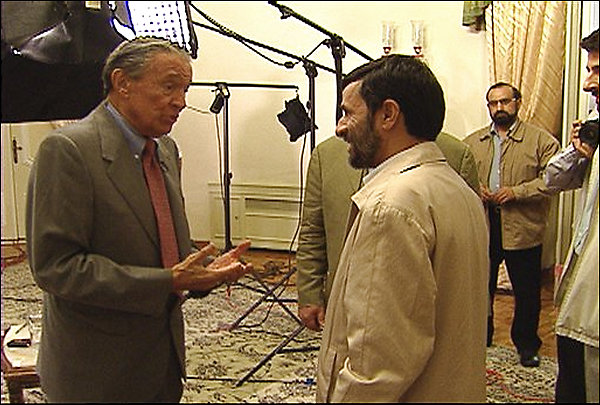 “Thus you will see how from a silly question many wise answers can be produced, and such is probably the cultural function of naive interviews.” —Umberto Eco
If you caught Mike Wallace's interview with President Ahmadinejad on 60 Minutes last Sunday, it was obvious that Wallace underestimated the sangfroid (GRE word!) of the Iranian president. Wallace confessed that he expected Ahmadinejad to be a "firebrand," rather than a smart professor (he still teaches a graduate level course), and acted accordingly. Wallace tried to badger the President into giving more "concise" answers, cutting him off, and asking him at one point to "just answer...yes or no." It was painful to watch Wallace attempt to get the President to speak more candidly.
Ahmadinejad handled Wallace masterfully. According to CBS's own transcript, the interview didn't even start with a question; Ahmadinejad started with an unequivocal proclamation: "I fully oppose the behavior of the British and the Americans." When Wallace tried to to ask him about Hezbollah, the tables were already turned. Ahmadinejad took control of the interview: "'Are you the representative of the Zionist regime? Or a journalist?' Ahmadinejad asked Wallace." Knowing that Wallace was in retirement and that this was probably his last interview, Ahmadinejad probably knew that this would make Wallace livid. "'I'm a journalist. I am a journalist,' Wallace replied"--pleaded, would be more accurate.
The interview did not get better for Wallace. "I think that you're getting angry," Ahmadinejad remarked. He was right. Wallace acted like a freshman frustrated at a professor's prolix way of answering questions. Ahmadinejad saw right through Wallace's attempt to appear tough and courageous: "'Do you, perhaps want me to say what you want me to say?' Ahmadinejad said to Wallace." Again, in these words, spoken in a very relaxed manner, Ahmadinejad displayed his control of the situation.
For his part, Ahmadinejad was rather successful in justifying his opinions and policies in terms of self-defense, independence, and international law. To justify his support of Hezbollah's actions, he appealed to the charter of the United Nations, which in his words affords every person "the right to defend his house." And to justify his words and actions against the U.S. occupation of Iraq—"I ask you, sir, what is the American army doing inside Iraq? Iraq has a government, a parliament"—he appealed to "international law" which on his account assigns the responsibility for providing security to "the occupying...army." "So," Ahmadinejad reasons, "I ask them...why are they not providing security?"
Moreover, Ahmadinejad deftly cast himself in the role of a great liberator and friend of oppressed people everywhere who desire peace. "I despise heinous action," he claimed, actions including Israel's recent invasion and occupation of Palestine, as well as America's invasion and occupation of Iraq, both of which have resulted in the deaths of thousands of people, including innocent women and children. America, he says, wants to build "an empire," but Iran isn't going to "sit idly by and watch them with our hands...tied." From this interview it is evident that Professor Ahmadinejad has learned all too well, from his experience and his studies, that in the face of empire, if you rest on your laurals, you'll lose them.
The Meek
"Jesus said the meek would inherit the earth, but so far all we've gotten is Minnesota and North Dakota."
---Garrison Keillor, "The Old Scout," published 8/13/2006
Sunday, August 13, 2006
Hypocrisy
Ilya's post brings to mind an important, albeit pernicious, undercurrent in political discourse today: hypocrisy or the other side of the coin, authenticity. Al Gore is proven to be a hypocrite, he comes nowhere close to approaching the carbon neutral lifestyle that he advocates for others. So he is a typical limousine liberal. That said, what of his views. This is ultimately the important point, what are the merits of the argument. Liberal commentators have for years bludgeoned Rush Limbaugh or Newt Gingrich or other advocates of "family values" for their hypocrisy. Newt Gingrich for one left his wife while on her death bed for one of his staffers, thus constantly referred to as a "first rate political intellect and fifth rate personal character". It is quite easy in these instances to resort to ad hominem attacks, literally taking it to the man. But what of the merits of their arguments? Do we take it to the man because we find that easier than challenging the premise of their arguments or the resulting conclusion? I suspect the answer is yes.
Friday, August 11, 2006
More on the Al Gore Predicament
John Tierney is not the only columnist opining on what I've now deemed the Al Gore Predicament (the discussion on this blog begins here and continues here), which arises from simultaneously preaching carbon-conscious lifestyle choices yet continuing to live day by day in a way that can be accounted as rather carbon intensive. Yesterday, Peter Schweizer of USA Today remarked that "if Al Gore is the world's role model for ecology, the planet is doomed." He went on to detail what many people see as Gore's excessive lifestyle, out of step with his concern to curtail Global Warming:
Public records reveal that as Gore lectures Americans on excessive consumption, he and his wife Tipper live in two properties: a 10,000-square-foot, 20-room, eight-bathroom home in Nashville, and a 4,000-square-foot home in Arlington, Va. (He also has a third home in Carthage, Tenn.) For someone rallying the planet to pursue a path of extreme personal sacrifice, Gore requires little from himself.I think it is true that Gore created this type of response himself, by virtue of the success of his own movie. As I predicted, "it will be Gore's moral achievement if the audience of his movie should come to accustom themselves with the facts, and demand real action from politicians." That's what they are doing, only "they" are more or less a number of right-wing pundits who want to paint Gore as your typical liberal hypocrite, and Global Warming as a red-herring. Schweizer concludes: "The issue here is not simply Gore's hypocrisy; it's a question of credibility. If he genuinely believes the apocalyptic vision he has put forth and calls for radical changes in the way other people live, why hasn't he made any radical change in his life? Giving up the zinc mine or one of his homes is not asking much, given that he wants the rest of us to radically change our lives."
Wednesday, August 09, 2006
Pie-Eyed Pickle of the Week: Joe Lieberman

Candidate Lieberman: you got bounced! Politics is not a nursery, either go home or plot a big comeback.
Overpopulation
 For background, see the post and ensuing conversation on the possible folly of attempting to live a modern lifestyle that is quote-unquote sustainable. The map above is supposed to show population density - concentration of red - around the world. I can't verify it, but it seems reasonable to me.
Overpopulation and environmental issues: how intertwined are they? And how different is the relationship between these issues in different parts of the world?
I ask because I often hear the subject of overpopulation come up in environmental discussions; but aren't the environmental issues related to overpopulation vastly differently in sub-Saharan Africa than in a suburb of Cincinnati? In what locales/situations is overpopulation enough of an issue (in terms of both impact and tractability) to warrant problem-solving action?
Tuesday, August 08, 2006
An Inconvenient Spoof
To go along with our question of the week a new video has appeared online mocking Al Gore’s fight against global warming and his film “Inconvenient Truth". In the short video Gore appears as a sinister figure who brainwashes penguins and bores movie audiences by blaming the Mideast crisis and Lindsay Lohan's shrinking waist size on global warming. The video is purportedly the work of a 29-year-old video-maker in Beverly Hills. But ABC News reports that the video appears to actually be the work of the public relations and lobbying company DCI Group. The company’s clients include Exxon Mobil. I personally prefer this cartoon version of Captain Planet, I mean Al Gore, better.
Pie-Eyed Party: Celebrate Mandingo's Imminent Demise TONIGHT!
As a result of Mandingo and His Queen's impending Trail of Tears out to our nation's capitol, the Pie-Eyed Network is cordially invited to a celebration in their honor tonight at the one, the only Sweeney's Saloon and the Dale Street Wine Bar. (Because of Mandingo's creeping middle age, and thus his maturing taste, he will be drowning in Zinfandel at the wine bar while the rest of us who remain young and fun will be enjoying pitchers with Her Queenship in the bar.)
Good times assured; better times optional.
Also, let's hear three Pie-Eyed cheers to Mandingo and His Queen as they embark on this Fantastic Voyage...Coolio-style.

Good times assured; better times optional.
Also, let's hear three Pie-Eyed cheers to Mandingo and His Queen as they embark on this Fantastic Voyage...Coolio-style.
Monday, August 07, 2006
Sustainable Living: The Predicament of the Environmental Movement
In response to my post belittling the idea of sustainable living from the point of view of one man who lives off the grid of modern life, Xtra, true to form, remarked that "The clearest way towards sustainable living is for all of us to pull our lips over our heads and swallow." Indeed, the quickest way to save the planet and stop global warming would be for everyone to kill themselves - but this of course would defeat the purpose, which is above all to live on earth, and to live here in a way that does not make the world increasingly polluted and uninhabitable for present and future generations. As A Green Cowboy, true to form, insisted, the best way forward is for everyone to do whatever they can, however minor, to live a more sustainable lifestyle. In principle, again, this sounds good. But it tends to fail in practice, or to fail to inspire practices consistent with the principles.
Let me explain. Rarely do I find myself, as I do today, agreeing with John Tierney's op-ed, in which he writes that "environmentalist preachers like Gore [should be held] to higher standards." Those who preach the need to live in an environmentally sustainable way lose their authority, their ability to influence the actions of others, when their own actions so obviously fail to embody their own values. As Tierney writes, while Gore's movie offers fine advice about cutting back on traveling and doing so in energy-efficient ways, "it would be even better if he journeyed to his lectures exclusively on Greyhound. But he seems to prefer cars and planes. When you tally up his international travel to inspect melting glaciers and the domestic trips between his homes—one in Washington and another in Nashville, not to mention the family farm in rural Tennessee featured in the movie—you're looking at a Godzilla-sized carbon footprint." Further, Tierney states that if Gore really wanted to save energy, he would also sell his second (third? fourth?) home. "If you're going to own a second home while ordering everyone else to carpool," Tierney writes, "you must atone for your excesses, and it's not enough just to offset the carbon."
One could object that Tierney could multiply such examples forever, until the absurd conclusion is reached that we must live like this guy, or just kill ourselves, in order to live in the name of a better society and environment. But this objection misses Tierney's point. The point is that the principles behind the idea of reducing carbon emissions or what have you are in practice ineffective, or at the very least need to be thought-out in greater detail. In other words, the principle of energy-efficiency currently functions no differently than the concept of recycling, which allows people to claim that they are being responsible consumers - and to hiss at people who do not recycle - while they are consuming more and more. Likewise, the idea of, say, public transportation allows people to claim that they are helping the environment while at the same time they are contributing to its pollution by riding the bus. Such things are falsely called a step in the right direction. Instead, the right direction consists in an absolute reduction of waste and an absolute reduction in carbon emissions. As far as the environment is concerned, anything less is still relatively more. That is to say, what counts as a relative reduction in pollution on the part of humans, still counts as an absolute increase in the pollution of the environment. This is the predicament of the environmental movement.
St. Paul Riverfront
MNObserved commented in my previous post on cycling in St. Paul that I must be crazed to suggest industrial vacancies along the riverfront in Minnesota's fairer city. Respectfully, I dissent.
If you were to venture past the High Bridge, down around the Randolph Avenue area, you will notice a landscape utterly devoid of forward-thinking urban planning. The argument here is not whether there are industrial vacancies or not (though I beg you to witness a brand-new "light industrial" complex sitting completely empty, having no particular reason to exist other than to take up space), it's why the riverfront continues to exist in the state that it is.
You are correct that there's a new Science Museum, Eagle Street park, etc. etc. There's even the new condo/apartment buildings (Soviet-style, as you mentioned) that have cropped up. St. Paul has done a fine job reconstructing about three blocks of the riverfront. But the city has the wonderful advantage of having miles of riverfront that it has for decades squandered. Yes, there are logistical reasons for some of that development. But there are no reasons (that I can see) why that sort of development (heavy industrial) has to exist side-by-side with high-density residential around the city's greatest natural resource. The river would be better left as a nature sanctuary than to continue to delapidate in the state that it's in.
And, yes, there are train tracks. But there are myriad places that have train tracks without detracting substantially from the beauty of a natural landscape.
Now, there are (and have been) stirrings of turning this around. On the West St. Paul side of the river there is the somewhat-maligned Bridges of St. Paul project. The city has also had a long-range plan in play for greater integration between the river, residential, and commercial planning. I'm confident and optimistic that eventually St. Paul will have a vibrant riverfront that both protects the natural wonder and environmental sanctity of the river while capitalizing on it through "smart growth." None of this, however, changes the sad fact that the St. Paul portion of the Mississippi River has largely been wasted - both by being sold out for industrial purposes and as a result polluted - for years and years.
Sunday, August 06, 2006
Cycling the Twin Cities
 I've taken the opportunity of My Lovely being on a business trip this weekend to explore the city I love - St. Paul - and part of that other city - Minneapolis - on my 1986 Diamondback Momentum bicycle. My routes:
- Friday - Starting at Dale Street, I went down Summit Avenue to the Cathedral, where it turns into John Ireland Blvd. I then wrapped around the lawns in front of the Capitol, and entered downtown St. Paul on Cedar Street. After crossing over I-35E, I scooted down 11th Street to Robert Street where I was going to go to Aroma's Art House, which turned out to be closed. I then decided to maneuver down 9th Street to Temperance to 7th Street, where I took a right on Wacouta. This took me down past Mears Park to 4th Street, where I took a left, passed the Farmer's Market and stopped in at the Black Dog Coffee and Wine Bar. After a couple hours at Black Dog, I rode back up 4th Street, then Kellogg Blvd. to West 7th. I took 7th to Grand Avenue, crossed I-35E again, and then tackled the Grand Avenue hill (not to be confused with the suicidal Ramsey Hill).
- Saturday - Fellow PePper Ilya and I decided to meet at the Cliquot Club, so I ventured over to South Minneapolis. I took summit Avenue, past St. Thomas, to the Mississippi River Blvd. pathways. I followed that to 27th Street, crossed the bridge (that offers a spectacular view) and then down Franklin. I met Ilya and we rode through the Seward neighborhood to Cliquot. After a chocolate chip cookie, some green mango tea, and incredibly high-minded conversation, I rode back to the Minneapolis side of Mississippi River Blvd. up to Lake Street. I crossed the Lake Street Bridge, where on the St. Paul side I carried my bike down the steps. I then retraced my route back home.
- Sunday - After a three-egg omelet with cottage bacon, mushrooms, and pepper jack, I decided to further explore St. Paul. I rode through my neighborhood to St. Clair, and took that down across West 7th near the river. I followed the bike route to the High Bridge, and briefly toyed with the idea of going into West St. Paul. Deciding I probably didn't have the energy for that today, I kept going along 7th to the old Ramsey House, then down to the paths below the bluffs along the river. I took that to Randolph, crossed 7th again, then turned right on Victoria, where I thought I might be able to go through the Linwood Recreation Center area. Unfortunately, I never found Linwood from that route. Instead I had to turn on Jefferson (where I suffered the indignity of having to walk my bike halfway up a hill), followed by a left on Lexington, and finally a right on Grand Avenue to home.
During these journeys, while not incredibly long or extensive, I made some observations. And I'm sure you want to read them. So here you go:
- It almost always takes a shorter time to get from point A to point B than I originally anticipated. My trip to Minneapolis took 29 minutes exactly, while I thought it would take 45 to 60 minutes.
- Each trip left my legs less sore than I thought I would be. For example, when I biked to downtown St. Paul and then climbed the hill back up Grand Avenue on Friday, I figured I'd be finished for a day or two. The next day, however, I was reenergized and ready to go.
- Both cities are great places to bike through, although I much prefer St. Paul. Summit Avenue makes an easy thoroughfare and because there is less traffic downtown (and more residential zoning) its less pressure. Of course, I didn't spend a lot of time cycling in Minneapolis, so my opinion may be biased.
- The St. Paul riverfront represents decades of what must be some of the absolute worst city planning in the country. The city's greatest natural resources has been marred by heavy industrial zoning, and is now littered with anonymous vacant factories and plants. When driving down it you notice it, but when you bike down there you become appalled at the utter lack of forward-thinking.
Related Link: Map of St. Paul bicycle paths
Saturday, August 05, 2006
Relearning the Lessons of Military History
Some things change, only because some things never change. History, upon careful examination, shows us many important truths about human life. There is one truth that Israel and the U.S. has clearly failed to learn, and that is that war should be treated as an extension of politics, and hence the most important thing is to build defenses in the people.
When cavalry and artillery were gaining popularity in early modern Europe, Machiavelli in his Art of War continued to emphasize the importance of infantry, which was regarded as comparatively worthless. Nobody believed that foot soldiers, who we now refer to as "boots on the ground," could withstand the charge of cavalry. This was thought impossible until the mountaineers of Switzerland proved everyone wrong.
Once again, we are witnessing the remarkable ability of foot soldiers - "insurgents" - to withstand shock and awe campaigns carried out through aerial assaults. This feat is only underscored by the history of America's "Green Zone" in Iraq - a highly fortified fortress of steel and concrete - which has proven to be an embarrasingly weak outpost of security. If our army generals were actually trained in the art of war, they would know that the best fortress is built out of people, not out of steel.
One needs to look no further than Hezbollah to see the military folly of relying on heavy artillery to win battles against skilled foot soldiers. As Sabrina Tavernise writes in this excellent analysis of Hezbollah's roots in the people of Lebanon,
Hezbollah is the people. If there is no better fortress than the people, the battle for Baghdad has long been lost.
When cavalry and artillery were gaining popularity in early modern Europe, Machiavelli in his Art of War continued to emphasize the importance of infantry, which was regarded as comparatively worthless. Nobody believed that foot soldiers, who we now refer to as "boots on the ground," could withstand the charge of cavalry. This was thought impossible until the mountaineers of Switzerland proved everyone wrong.
Once again, we are witnessing the remarkable ability of foot soldiers - "insurgents" - to withstand shock and awe campaigns carried out through aerial assaults. This feat is only underscored by the history of America's "Green Zone" in Iraq - a highly fortified fortress of steel and concrete - which has proven to be an embarrasingly weak outpost of security. If our army generals were actually trained in the art of war, they would know that the best fortress is built out of people, not out of steel.
One needs to look no further than Hezbollah to see the military folly of relying on heavy artillery to win battles against skilled foot soldiers. As Sabrina Tavernise writes in this excellent analysis of Hezbollah's roots in the people of Lebanon,
They cover medical bills, offer health insurance, pay school fees and make seed money available for small businesses. They are invisible but omnipresent, providing essential services that the Lebanese government through years of war was incapable of offering. Their work engenders a deep loyalty among Shiites, who for years were the country's underclass and whose sense of pride and identity are closely intertwined with Hezbollah. Their presence in southern Lebanon is so widespread that any Israeli military advance will do little to extricate the group, which is as much a part of society as its Shiite faith. "The trees in the south say, 'We are Hezbollah.' The stones say, 'We are Hezbollah,' " said Issam Jouhair, a car mechanic. "If the people cannot talk, the stones will say it."
Hezbollah is the people. If there is no better fortress than the people, the battle for Baghdad has long been lost.
Scientist to global-warming skeptics: Quit calling me your friend

Did anybody else see the op-ed piece in the NYTimes on 28 July entitled "Cold, hard facts?"
It was written by Peter Doran, whose 2002 paper in Nature caused quite a stir: he and his colleagues concluded that more of Antarctica had actually cooled, rather than warmed, from 1966 to 2000. So much for global warming, right?
Well, yes, if you are an armchair scientist looking for any title to possibly support your point of view. Doran says "Our results have been misused as 'evidence' against global warming by Michael Crichton in his novel 'State of Fear' and by Ann Coulter in her latest book 'Godless: The Church of Liberalism.'"
Doran argues emphatically that his research has been misinterpreted. First, a large part of the continent was indeed warming during that period. Second, subsequent modelling has indicated that the lack of warming he and his colleagues found is related to the hole in the ozone layer over Antarctica; as the hole heals, the continent will likely begin to warm. Third, other research has contradicted his results; while he stands by his paper, the conclusions are being debated.
Thus, he states: "I would like to remove my name from the list of scientists who dispute global warming."
P.S. - Michael Crichton is a tool, by the way. His book "State of Fear" includes an "author's message" at the end where he claims to lay out some truth concerning environmentalism, after penning a work of fiction.
Basically, he slams environmentalism for being narrow-minded and chauvinist, says environmentalism is working to build and sustain a modern imperialism of developed nations, and slams most environmental science for being biased.
Specifically, two of his messages included are:
"I believe people are well intentioned. But I have great respect for the corrosive influence of bias, systematic distortions of thought, the power of rationalization, the guises of self-interest, and the inevitability of unintended consequences."
"Everybody has an agenda. Except me."
Right. No agenda. Michael Crichton, alone, is able to stand strong against the corrosive influence of bias and avoid the guise of self-interest.
Tool.
Friday, August 04, 2006
Week in Review: Pie-Eyed Self-Pity Edition
Well, this was the week that was. (?) Drink up to another seven days of mediocrity at the Pie-Eyed Picayune. And, really, Mandingo...we know that you're sooo busy, but what happened to "Phraseology"? Another piece of refuse in the recylcing bin of history?
- Ilya offers an explanation for his own pasty whiteness; then, he expounds on Augustine
- Mandingo to the PeP: Cry for me!
- Xtra argues against giving himself a raise. That's so unbecoming a Republican...
- "That guy" puts things into perspective for Il, leaves the rest of us perplexed
- PiedPiper: Establishing the new school of PiedPiperian Thought
Pie-Eyed Poll: Captain Planet Edition
Another week, another Pie-Eyed Poll. I was particularly interested in the result of our last poll, "What's your favorite international crisis?" "Other" garnered nearly as many votes as the top choice "Iraqi quagmire," and almost twice as many votes as "Global warming." (Sorry, GC.) I'm very curious what "Other" international crises folks had in mind. And what about the Kashmiri separatists! The results:
- Israel-Hezbollah conflict - 9%
- Iraqi quagmire - 30%
- Iran's nascent nuclear weapons program - 3%
- North Korea's saber-rattling - 3%
- Russia's slide toward authoritarianism - 9%
- Kashmiri separatists in India - 3%
- Global warming - 15%
- Other - 27%
In honor of the showing by global warming, we have an all-environmental poll this week. Remember: vote early, vote often!
Pragmatism
 Pragmatism is a word that has been sticking out in my mind for quite a while now. Progressive pragmatism, to be more specific. I don't know if that phrase has been coined yet; if not, I hereby copyright it before the political jackals steal it.
What I mean by progressive pragmatism is recognizing societal problems, outside the context of the bipolar American political model, and working towards pragmatic solutions. It involves bringing numerous voices together and striking a path of sensical compromise. The players need to enter negotiations knowing that their self-interests may not be fulfilled, but also knowing that the other players won't take advantage of that fact, and in reality that all players are willing to give up some parts of their self-interests.
An example of where this concept worked is welfare reform, which Robert Samuelson discussed in his Newsweek column this week. (Yes, I just linked to Newsweek...again!) Despite calls for elimination on the right, and calls for no change on the left, a solution was achieved. Granted, the solution wasn't foolproof, and there are holes that ought to be filled. But overall, welfare reform has been a success in striking a middle ground to win a pragmatic answer.
That reform, however, came in very different times. A Democrat in the White House, a Republican majority in the House (and maybe the Senate...I don't remember). No large-scale conflict. A booming economy. Today, we find ourselves in quite a different situation. We have a poisonous political climate, with lawmakers feelings forced to huddle in their corners. Meeting in the middle and working out compromise is seen as a betrayal.
The primary problem with this is that it causes people to lock up their viewpoints in the relative safety of their political perspectives. If Republicans can make themselves believe that there is a "debate" over global warming, then they don't have to make concessions for progressive pragmatic environmental reform. If Democrats can make themselves believe that Social Security is a sustainable program, they don't have to make concessions to make the program better and stronger. (Although I also don't believe Republicans are willing to seek other or additional solutions beside the one that failed miserably last year.)
The most recent example, of course, is the minimum wage increase/estate tax elimination bill that just failed in the Senate. This is a case of bipolar politics gone awry. Rather than working to achieve their aims, lawmakers on both sides of the aisle failed to win any of their objectives. If Democrats had been more willing to work with ideas like Xtra's, and Republicans had been more willing to concede on estate taxes, perhaps a solution could have been reached that would have fulfilled (partially) the self-interests of both sides.
Thursday, August 03, 2006
Let's Put Things In Perspective
In the light of this guy, don't tell me so-and-so lives a simple, sustainable life because he rides a bike, carpools, grows his own and eats natural foods, recycles and reduces waste, and makes environmentally friendly "alternative" lifestyle choices. This guy is the alternative. Otherwise, you're pretty much like everyone else: hooked into this modern life with your reliance not on your own self, but on cars, phones, running water, and things that run on electricity to bring you all that you expect and enjoy. It goes with the territory, so to speak. That is, unless you live on this guy's territory - but you don't. None of us do.
Random Thought
I was reading a transcript of a Panel held at the Brookings Institute on Welfare Reform and beyond and a notion put forth by Eloise Anderson of the Claremont Institute particularly struck me:
Our social policies for men, at least those of age, boil down to incarceration.
Our social policies for men, at least those of age, boil down to incarceration.
Minimum Wage Thoughts: Transition Away From the Welfare State
I just thought I would chime in on the minimum wage debate that is currently not raging in d.c. because congress is in recess (which is the best thing for democracy). My disclaimer: I believe the minimum wage should be $0. Helping the working poor is a compelling end but ultimately I question how effectively minimum wage achieves this end. I think from both a politicial and policy standpoint we could much more effectively help the working poor through expanding the Earned Income Tax Credit (EITC) or through a negative income tax.
We value work as a society. There is a certain dignity achieved through working that manifests itself in a number of areas. People respect those that work, and those that work have an elevated self-worth. I would also argue that employment has positive implications for the family structure which itself has ramifications but that is an argument for another time. As a country we are much more supportive of public assistance that is conditioned on work. A minimum wage that really provides ample subsistence will have significant negative employment effects while diluting the benefits by dispersing them over a broader population than intended. I think a more effective means of finessing this tension lies with either increasing the Earned Income Tax Credit (EITC) or instituting a negative income tax.
XTRA's "Facts":
I think there are certain elements that we can all agree on in terms of discussing a minimum wage hike (or maybe not and thus we'll call these Xtra's "facts"):
1. The proposed minimum wage hike (about $1.50 per hour), which is modest, is unlikely to have a significant impact on the employment of those currently earning the minimum wage.
2. That said, it is clear that minimum wage does have a negative employment effect as the imposed marginal cost on the employer may exceed the value of a given employee's labor. We call this the law of demand, for evidence of this phenomena look at Europe. Points 1 and 2 appear to be in competition but in fact this tension speaks to the economic concept of elasticity.
3. The minimum wage is intended to help the working poor and does so (though, in my view not without adverse effects, see point five).
4. A significant portion of those earning minimum wage are either retirees supplementing their retirement income, spouses supplementing a household income, or students (high school and above) that are not part of impoverished families (looking at a DHHS study during the Clinton administration I would say this non-working poor population approaches half, that 75% of minimum wage workers work under 20 hours per week is a particularly telling statistic). I expect this point will be subject to quibbles, thus my "Xtra's Facts" qualifier.
5. Over the long term, the less one works the fewer skills/experience one will acquire thus reducing their lifetime earnings. This is acutely problematic for those with less education as a job is their only avenue to attain marketable skills.
Xtra's "facts", should you choose to entertain them at least, present several problems with the minimum wage and its effectiveness. A vast pool of people, who we don't necessarily define as the working poor are affected by minimum wage. So it is not an effective transfer as far as precision is concerned. The minimum wage imposes greater costs than intended as it benefits others than the working poor. We are effectively asking consumer and employer alike to subsidize the wages of a population that doesn't necessarily need or warrant this form of assistance.
And it is a transfer. When we advocate a minimum wage hike what we are doing is forcing employers to pay more for an employees labor than the employer would have otherwise. The essential difference between this and any other transfer is that the benefit is transfered from the employer as opposed to the general taxpayer. Proponents would argue that cost of the minimum wage is borne by the employer. I think proponents of the minimum wage are hard-headed to a fault on this point. A large part of support for minimum wage emanates from romantic notions of the social contract or corporate social responsibility or plainly to stick it to big business. I think sticking it to employers for the sake of itself is idiotic. Regardless of the motivation, the employer will do everything possible to avoid absorbing the costs of a minimum wage hike. Employers will either try to pass the cost on to consumers or do without the employee. How this is progressive escapes me unless progressivism is measured in proportion to its antagonism towards businesses. On a broader level, this is reflective of a tendency amongst "progressives" to conflate in their own minds how things ought to work and how they do work.
The earned income tax credit or a negative income tax is essentially the opposite of taxes. If your paycheck is below a certain level, your pay is supplemented by the taxpayer. It's like getting your tax refund without having to pay taxes in the first place (though, you do have to work, thus the earned part). The EITC enjoys bipartisan political support, does not have the negative employment effects, and could be precisely targeted to those that most need assistance. At a broader social policy level, we have been moving away from the notion of the welfare state to something along the lines of a "Work Ethic" state (I am stealing this phrase from Mickey Kaus) and I think such a step would accelerate this movement.
Helping the working poor is a compelling end. The minimum wage simply isn't an effective means towards that end. Our transition from a welfare state to a "work ethic" state (which may be merely a figment of my imagination), is a positive trend and should be continued. It impacts not only the level of poverty but the pathologies associated with poverty. Removing the minimum wage and offsetting the difference with the Earned Income Tax Credit would be a good first step to that end.
Wednesday, August 02, 2006
Mandingo Bares Soul, Beats Breast
Pick yourself up out of the gutter, 'Dingo. Ask yourself this question: Am I a man, or am I a mouse? Write the damn paper. Move to the East Coast. And get with the program. I trust you will find no sympathy within the Pie-Eyed Network.
That being said, we all deal with both procrastination and writers' block. They suck. Surefire cure: Just start typing. Type anything that remotely deals with the topic at hand. Eventually, things will start aligning and coming into focus. Pretty soon you'll be humming along.
My guess, however, is that you know what you need to do. Your self-importance and self-loathing just got the better of you.
Monday, July 31, 2006
Sustainable Peace: An Augustinian View
Just as those who suffer the calamities of war live in hope of the future, President Bush, looking forward, hopes to see war in the Middle East make a long, lasting, sustainable peace emerge. For what is the ultimate purpose of war if not peace? But both sides desire to fight to gain peace with glory, that is, through victory. After all, wars are fought to be won, no less. When one side conquers the other there will be peace.
But it will not be sustainable, for such peace is a poetical fiction, unavailable on earth. Peace on earth is always a doubtful good in the sense that it always admits of either improvement or increase, and so men who wish to disturb the present peace do so not because they hate peace, but because they desire the present peace to be exchanged for one that better suits their wishes. Thus it is that the major disturbers of peace are often those who claim to be upholding it.
The Middle East will enjoy unbroken peace so long as neighboring peoples refrain from attacking each other. But no country, not even the U.S., feels that it possesses its dominion so securely as not to fear attack by its enemies. As long as there is this dread of attack, the earth will never be a dwelling place of lasting peace and security. On earth, ceasefire is the best peace available.
Friday, July 28, 2006
When to Spot an American Outdoors
Americans spend most of their time indoors. And one can make a pretty good generalization about when Americans venture out of their climate controlled environments. As political scientist Sebastian de Grazia forecasted in his Of Time, Work, and Leisure (1962):
Together, indoor work and indoor at-homeness [after work, as well as indoor free-time in general] may make the American timorous of outdoor temperatures below 60º or above 85ºF. Certainly his ingenuity at the technology of central and individual unit heating makes it difficult to feel cold in America without deliberately going ice skating, or being foolhardy enough to take a walk instead of a ride on a wintry Sunday. He is somewhat better at withstanding heat and humidity than cold, but with the coupled heating and cooling systems now appearing it won't be long before he feels suffocated on the un-air-conditioned summer street. (184-185)
Pie-Eyed Poll: Choose Your Own Adventure
With all precinct reporting (32 votes! Wo!), the Pie-Eyed Poll results are in for the week. The question: How do you think the Israel-Lebanon conflict will play out? The results:
- Diplomatic solution brokered with help from the US - 6%
- Diplomatic solution brokered without help from the US - 6%
- Continued escalation resulting in Israeli occupation - 25%
- Continued escalation drawing Syria and/or Iran into the conflict - 22%
- World War III - 19%
- Israeli withdrawal; Hezbollah disarmament; multi-ethnic drum circle on the border - 22%
Personally, my vote was for Israeli occupation, which now seems unlikely, but you never know. The sleeper favorite, though, really surprised me. Obviously, many of you in the Pie-Eyed Network are optimists who enjoy drum circles.
This week, we've got a related poll. With all that's going on in the world, we want to know "What's your favorite international crisis?" Vote early; vote often, PePpers!
Week in Review: The Silence is Deafening Edition
The lazy, hazy, dog days of summer are upon us, and the Pie-Eyed Krewe is feeling the effects. Sure, it's been a slow week...but what about the content? Marginal, as usual.
- Anti-Everything offers everyone a chance to make an "informed decision" on the AG race, while Xtra throws down his endorsement from light-years away
- Ilya comes out of the closet as a pedant. As if we didn't know...
- AFF comes back with a vengeance, discussing the finer points of keeping prisoners alive in order to kill them
- The first Pie-Eyed Party consisted of three contributors, two baskets of free popcorn, some condescending laughter at those "other" people participating in a trivia game, and one-and-a-half beers shared among all
- A Green Cowboy seeks to resolutely crush those who live on the coasts
- Ilya, Maureen Dowd, and yet another "zing" ... weird
MOVIES/BOOKS: Kubrick's "Eyes Wide Shut"; Schnitzler's "Dream Story"
 Stanley Kubrick's last masterpiece, "Eyes Wide Shut," released after his death in 1999, did not draw great praise from film critics; like so many overly-hyped movies, it opened with great expectations—sparked by the great secrecy surrounding its production—that it was bound to disappoint. In America, the unreal yet worldly orgy scenes were censored so the movie would earn an 'R' rating. Unfortunately, many critics failed to understand that those scenes were not meant to be scary or charged with sexual energy; they were meant to be strange and phantomlike, seeing as Dr. Bill (Tom Cruise) found himself in a large mansion among lunatics? conspirators? some religious sect? jokers? We never really know. To see the uncensored, 'NC-17' version, one must obtain the European version, as the European film industry in contrast to Hollywood is more mature about sex on the silver screen. As NYT critic Elvis Mitchell observed, "A foreigner judging the United States by its films would think Americans spend more time running from exploding fireballs than having sex." Indeed, when is the last time you saw a good movie about sex?
"Eyes Wide Shut" is based on Arthur Schnitzler's novella, Traumnovelle ("Dream Story"). Kubrick's is a story about erotic desire and fidelity, whose primary lesson is that, as Dr. Bill (Tom Cruise) says at the end of the movie, "dreams are never merely dreams." We come away from the movie questioning the reality of Dr. Bill's ostensibly real adventure consisting in a succession of sexual encounters in a world that feels more and more unreal. And in the second half of the movie, Dr. Bill himself resolves to clear up the mystery of his adventure, to find some meaning in what he has witnessed. Faithful to Schnitzler's novella, Kubrick troubles the distinction between dreams and reality, showing that reality is never entirely real, just as dreams attend and belong to our reality.
Like so many of Kubrick's movies, you have to watch them over and over again to see the things that are not readily apparent. For instance, the experiences of both Dr. Bill and his wife, Alice (Nicole Kidman), testify to the theme of the sudden power of male sexuality over females. This theme is spelled out more explicitly in "Dream Story" than in the movie. As Schnitzler writes, "there may be hours or nights, he thought, in which some strange, irresistible charm emanates from men who under normal circumstances have no special power over the other sex."
If you haven't seen the movie, see it; if you have, see it again.
Xtra's Challenge; Pied's Retort
In the comments of my post last week on Supreme Court Justice Antonin Scalia's essay in the book A Matter of Interpretation: Federal Courts and the Law, our eminent Xtra challenged my assertion that Scalia's dissent in Romer v. Evans contained what I refer to as a gay conspiracy theory. In the same vein as Justice Scalia, I dissent. A selection of quotes from Scalia's dissent in that very intriguing case:
First, some background about this case. Colorado had passed Amendment 2, which essentially allowed landlords, employers, and other similarly appointed folks to deny homosexuals housing, jobs, etc. based on their sexual orientation. In the majority opinion striking down the amendment, Justice Anthony Kennedy applied minimal, rational-basis review citing the fact that it violated the equal protection clause of the 14th Amendment to the US Constitution. Obviously, there was much more involved in this case than I'm willing to discuss here, but that's the gist of it.
Scalia, in dissent with Rehnquist and Thomas, does three things here:
First, he attempts to turn the law on its head by proclaiming that the Colorado amendment didn't deny equal protection, but rather that it prevented homosexuals from obtaining "preferential treatment." This, of course, is a complete farce. As Kennedy pointed out, the law's single objective was to deny protection to a class of individuals based solely on a single trait.
Second, Scalia attempts to paint a picture of homosexuals as a politically powerful minority that does not need equal protection. Scalia appears to believe homosexuals strategically amass themselves and their wealth in order to create a favorable social climate throughout the nation.
Finally, as many conservatives often do, Scalia compares homosexuality to polygamy and bestiality, trying to make a connection that allowing equal protection to homosexuals will open the door to equal protection to all sorts of other "conduct" that society morally disapproves. It is not homsexuals, Scalia asserts, that he has a problem with, it is homosexual conduct.
Similar arguments, of course, have been used throughout the ages to justify unequal and, in fact, immoral, treatment of disfavored minority groups. In several passages of Scalia's dissent, one could easily substitute "homosexual" and "homosexual conduct" with "Jew," "Asian," "race," or "religion." Scalia reaches for the moral high ground, as most arrogant social conservatives do, but it doesn't take much searching to find his crass and homophobic message.
"The Court has mistaken a Kulturkampf for a fit of spite. [Amendment 2 of the Colorado state constitution] is not the manifestation of a 'bare desire to harm' homosexuals, but is rather a modest attempt [to] preserve traditional sexual mores against the efforts of a politcally powerful minority to revise those mores through the use of the law..." Romer v. Evans 517 U.S. 620, 636 (1996).
“The Court's opinion contains grim, disapproving hints that Coloradans have been guilty of "animus" or "animosity" toward homosexuality, as though that has been established as un-American. Of course it is our moral heritage that one should not hate any human being or class of human beings. But I had thought that one could consider certain conduct reprehensible--murder, for example, or polygamy, or cruelty to animals--and could exhibit even "animus" toward such conduct. Surely that is the only sort of "animus" at issue here: moral disapproval of homosexual conduct …” Romer v. Evans 517 U.S. 620, 644 (1996).
"The problem (a problem, that is, for those who wish to retain social disapprobation of homosexuality) is that, because those who engage in homosexual conduct tend to reside in disproportionate numbers in certain communities … have high disposable income …
and, of course, care about homosexual-rights issues much more ardently than the public at large, they possess political power much greater than their numbers, both locally and statewide. Quite understandably, they devote this political power to achieving not merely a grudging social toleration, but full social acceptance, of homosexuality.” Romer v. Evans 517 U.S. 620, 645, (1996).
First, some background about this case. Colorado had passed Amendment 2, which essentially allowed landlords, employers, and other similarly appointed folks to deny homosexuals housing, jobs, etc. based on their sexual orientation. In the majority opinion striking down the amendment, Justice Anthony Kennedy applied minimal, rational-basis review citing the fact that it violated the equal protection clause of the 14th Amendment to the US Constitution. Obviously, there was much more involved in this case than I'm willing to discuss here, but that's the gist of it.
Scalia, in dissent with Rehnquist and Thomas, does three things here:
First, he attempts to turn the law on its head by proclaiming that the Colorado amendment didn't deny equal protection, but rather that it prevented homosexuals from obtaining "preferential treatment." This, of course, is a complete farce. As Kennedy pointed out, the law's single objective was to deny protection to a class of individuals based solely on a single trait.
Second, Scalia attempts to paint a picture of homosexuals as a politically powerful minority that does not need equal protection. Scalia appears to believe homosexuals strategically amass themselves and their wealth in order to create a favorable social climate throughout the nation.
Finally, as many conservatives often do, Scalia compares homosexuality to polygamy and bestiality, trying to make a connection that allowing equal protection to homosexuals will open the door to equal protection to all sorts of other "conduct" that society morally disapproves. It is not homsexuals, Scalia asserts, that he has a problem with, it is homosexual conduct.
Similar arguments, of course, have been used throughout the ages to justify unequal and, in fact, immoral, treatment of disfavored minority groups. In several passages of Scalia's dissent, one could easily substitute "homosexual" and "homosexual conduct" with "Jew," "Asian," "race," or "religion." Scalia reaches for the moral high ground, as most arrogant social conservatives do, but it doesn't take much searching to find his crass and homophobic message.
Thursday, July 27, 2006
Zinger: "It's not even like watching paint dry..."
From Dowd's latest column, "The Immutable President":
Zing!
For a definition of a Zinger go here, for Dowd's previous zinger, go here.
That’s what’s so frustrating about watching him [G.W. Bush] deal — or not deal — with Iraq and Lebanon. There’s almost nothing to watch. It’s not even like watching paint dry, since that, too, is a passage from one state to another. It’s like watching dry paint.
Zing!
For a definition of a Zinger go here, for Dowd's previous zinger, go here.
Wednesday, July 26, 2006
Quit building on the coasts, dammit!
 July's National Geographic magazine had a feature story on the increasing degradation of our nation's coasts, particularly in light of the impending boomer retirement.
Today's NYTimes had an article about climate researchers who disagree on the importance of human-caused climate change in hurricane trends, but who all agree that our country is building too much too fast on the coasts. These trends are encouraged by friendly disaster insurance created through political pressure.
This isn't neuroscience, theoretical ecology, rocket science, or even a challenging rubik's cube. This is straightforward: our coasts are important, and they are delicate.
As the interface between two ecosystems - terrestrial and aquatic - our coasts are critically important for our ecological health (remember, we are part of these ecosystems just as much as seaweed, horseshoe crabs, squirrels and beetles). The coasts are also extremely dynamic...a simple example: beaches are supposed to be destroyed during storms, a process balanced by slow rebuilding during times of gentle wave action.
Human construction to interrupt natural processes like beach building, tidal movement, wetland migration, barrier island formation, etc, is going to screw up the coast. No two ways about it. We need to get serious about mitigating our coastal damage, and being thoughtful about new construction.
Khrushchev's shoe, Ivan Drago, Hunt for Red October...
 The region of the world that was home to the former Soviet Union has, unfortunately, a stereotyped identity in the minds of many Americans. A certain interpretation of the iron-fisted strength of the "motherland."
In the news on NPR this morning, there was a story on growing tension at the Russia/Georgia border, where a local warlord has declared an uprising against Georgia. Georgia claims this warlord is being supported by Russia. Russia has warned Georgia that it will not tolerate instability near its borders.
The Georgian president (or a spokesperson - it was hard to tell) had this to say about the warlord and his nascent uprising (I'm trying for verbatim, but give me a little slack):
"The revolution will be resolutely crushed...the only kind of negotiations I can make will be for the size of their cells..the president and his team will make their mothers weep."
You can't make this up.
Sunday, July 23, 2006
Saddam hospitalized, fed with tube

That's the actual Strib headline currently gracing the front page (though not front and center) of the dot-com.
There's a certain irony about giving Hussein the 'ol Fristy McDoctor Schiavo treatment. Because of his hunger strike, he's too weak to go through the trial that will ultimately lead to his hanging. So he gets put on a feeding tube to give him strength back. So we can kill him.
The fact that we can't allow him to starve himself to death is an insight into the way the community perceives justice. If he were to starve himself, it would mean that he had the agency and the power to do so. The courts and the justice system were powerless to stop his agency. Yet, because we want justice--or some form of closure, perhaps--we are forced to go through the farce of saving him so we can kill him.
Friday, July 21, 2006
Phraseology: Pedantic
Though I've used Mandingo's "Phraseology" posts as occasions to question his linguistic competence, and more generally to make cheap shots at his pie-eyed posts, today I'll do him the honor of considering his recent post as worthy of this piece of phraseology. Besides, someone has got to keep an eye on the phraseology of the self-proclaimed phraseologist.
Before leaving from Minneapolis to D.C., Mandingo shot off a quick "ripost" to my "pedantic" remarks about the very definition of "phraseology." "Pedantic" was an apt word to use there. As Thomas Wolfe wrote in his short story "A Portrait of Bascom Hawke,"
Before leaving from Minneapolis to D.C., Mandingo shot off a quick "ripost" to my "pedantic" remarks about the very definition of "phraseology." "Pedantic" was an apt word to use there. As Thomas Wolfe wrote in his short story "A Portrait of Bascom Hawke,"
there was something sneering and pedantical in the way he pronounced each word, biting it off with a prim, nasal and heavily accented enunciation in the manner of certain pedants and purists who suggest by their pronunciation that language in the mouths of most people is vilely and carelessly treated, that each word has a precise, subtle, and careful meaning of its own, and that they—they alone—understand these matters.My attitude, vain of language usage, cannot be spelled out any better than that.
Attention: Xtra's Endorsement for the Minnesota AG
Thanks to Anti's recent post, I feel adequately informed now to endorse Steve Kelley as the Democratic Nominee for Minnesota's Attorney General. Not that I would advise anyone to actually vote for him in the general election, he is a Democrat, and thus a National Socialist. In fact, I read a study that said all Democrats are Nazi's, and that explains a lot.
Pie-Eyed Poll: War in the Middle East
The results of our latest Pie-Eyed Poll shouldn't surprise me, but I guess they do in some ways. In answering the question of what should be done with North Korea's nukes, the largest response came in favor of multi-lateral regional talks. Fair enough. With 38 votes in, here are the results:
- Nuke 'em - 5%
- Defer to UN - 11%
- Withdraw troops from South Korea - 8%
- Push for multi-lateral talks - 37%
- Push for bi-lateral talks - 24%
- Nothing; wait patiently for Kim Jong Il to die - 16%
I encourage any and all to explain their rationale for voting as they did.
This week, in light of the tragic, muddled, and incredibly dangerous situation transpiring on the Israel-Lebanon border, I thought it would be worth asking our PePpers their thoughts on what should be done in the world's most volatile region. And, as always, vote early and vote often.Jen Mattson
 Alright here is what the candidate for attorney general looks like...now we can all make an informed decision based on her appearance.
Subscribe to:
Posts (Atom)