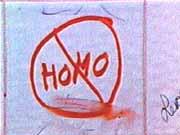
In response to the Church sexual abuse scandal of three years ago the Vatican has announced a new plan to root out homosexuals from the priesthood and seminaries throughout the United States.
Instead of taking a serious look at how the Church actively covered up this scandal and make radical reforms in the Church (i.e. allow priests to marry and allow women to become priests), they have instead decided to equate pedophilia with homosexuality even though there is no credible scientific research to support this claim and most experts agree that there is not a link.
This is just another example of the blatant hypocrisy of the Catholic Church. In a Church that is suppose to foster a sense of love for all people, they are instead perpetuating false stereotypes and creating even wider social barriers to the acceptance of others.
I guess the Westboro Baptist Church just found another ally.


10 comments:
Personally, you both make valid points. I would argue, and I'm a practicing Catholic (and one who can speak from 12, going on 15, years of Catholic education), that the Church is so large as to make it inherently contradictory. In many examples of Catholic doctrine, you can find an historical doctrine that contradicts it, or at least treats it in a different light.
For example, much to the dismay of apologists who insist priests must be unmarried men who prescribe to celebcy due to historical considerations, the Church actually did allow priests to marry and have families for about 1500 years of its existence (give or take a century). The practice was ended not for the purpose of making priests more representative of Christ, but rather to settle property disputes (as in sons inheriting Church property and many shady deals that followed).
One of the greatest contradictions in the American Catholic Church, however, has occurred among Catholics of the Republican Party. Our previous Holy Father, John Paul II, came out unequivocally against the Iraq War, insisting that it was unjust. Yet there was no call for Republican Catholics to be barred from receiving communion if they were pro-war. And our priests, at least the ones I've encountered, have been largely silent about a war that their Church has deemed unjust. Catholics were told, however, in the last election (most notably by a bishop in Colorado) that they should not receive communion if they planned on casting a vote for John Kerry or any Democrat, and if they did cast that vote (or even ponder it, I assume) they were required to receive the sacrament of Reconciliation and repent their sin! I'm sorry, but that's ridiculous.
The problem here, though, is that one can go round and round trying to fit the Catholic Church into modern political identities. My opinion is that the relationship simply doesn't work. And the Catholic Church isn't as uniform as many in the hierarchy would have others believe.
With all that said, the issue of homosexuality within the Church is a muddy one.
The simple doctrine the Church relies on when it comes to homosexuality (and other practices it deems as sin) is "hate the sin; love the sinner."
Now, I see many different interpretations, and contradictions within its six simple words. How can you "hate" a practice, yet "love" someone who identifies him/herself completely with that practice? And if this doctrine were read literally, why aren't gay Catholics more accepted than they are? They are supposed to be loved, after all, not shunned or subjected to witch hunts.
My personal feelings on this doctrine is that it means reaching out to the gay community in a respectful and open way. In my view, homosexuals do not commit a sin against God or the Church or anyone else. And even if they did, who am I to judge or decide that? I certainly am not a fourth compenent to the Holy Trinity (which would thus make it the Holy Quadrangle, I presume), and don't pretend to have authority over deciding whether a person sins or not. I have my own problems. Maybe it's a matter of emphasis, where I put more emphasis on the "love" part of the doctrine, while others put more emphasis on the "hate" part. Anyway you dice it, upon examination and analysis, you can see what I'm talking about when I say above that the Church isn't as uniform as some would have you believe.
Judd-
I can understand your viewpoints. And while I believe that the Church's just war doctrine when applied is more binding on an international Church congregation, I know it's certainly more binding than the Vikings-Bengals spread. I've heard the argument - just war v. abortion - and I don't think it holds water. The American Church, after the issue was raised by the Holy Father, should have been more vocal in explaining to people where the Church stands on war. The same goes with the death penalty. There are millions of so-called pro-life Catholics who have no idea that the Church equates the death penalty with abortion, and I've run across one person - Sr. Helen Prejean - who has spoken openly and forcefully on that subject. Was it a sin for Catholics to vote for George W. Bush, based on the fact that he sent a record number of inmates to death? Was it more of a sin because he did that, AND started an unjust war?
As for the equation of voting Democrat equals sin, I again have to respectfully disagree. You're right to say that no clergy of high standing (unless you consider a bishop in Colorado, who attracted national attention albeit via Bill O'Reilly) would say so explicitly that a vote for John Kerry or a vote for anyone who is pro-choice is a sin that demands reconciling. But this goes to the heart of the separation of church and state, except from the other side.
My Catholic faith inspires and informs my politics, but my faith is not solely my politics. John Kerry said something during one of the debates that reached to the core of what this means, "I will not legislate my religious beliefs." Personally, I would never encourage someone to get an abortion. But I would never tell a woman that she can't have an abortion. It's up to her own free will. Essentially, it's not the Church's choice, not the government's choice; it's her choice. Contrary to what the right-wing bloviators will have you believe, we are not a Christian nation. We are nation of Christians, Jews, Muslims, Hindus, Buddhists, atheists, Geists, etc., et al. Who am I, as a sole Catholic, to say to all these other groups who believe in their faiths as strongly as I believe in my faith, "I am right, you are wrong," when in all actuality none of us know the Truth (note the capital t). We are all merely struggling along, trying to live out our lives the best way we know how.
Faith and doubt go hand-in-hand. It's human nature to struggle with faith. When I run across people who say or act as if they have no struggle with their faith, I don't believe a word they say. Faith is an internal struggle that we work out as individuals through the venue we choose (or our parents choose). And I sure don't think I have the authority to tell someone else what or how they should believe, when I'm just trying to work out my own faith.
As for the homosexuality piece, I think you and I look at it differently and maybe we can get into that at another time.
As for married priests and female priests, I won't challenge most of what you say. The priests who are married now live mostly in Africa and other developing nations, and the topic, I think, is a bit taboo within the hierarchy. (Although there are cases in the American Church where Protestant ministers who are married have converted to Catholicism and the Church has allowed them to become priests, which again begs the question: Why not extend that privilege to all?)The Church turns a (mostly) blind eye because it has to for the survival of the Church. Women in the priesthood? I won't make a long argument for or against because I simply don't know enough about it. Yes, women have a strong role in the Church, but they don't have any power or influence. I've known a lot of nuns in my time, and they have been some of the most gentle, meek, and strong women I have ever known. But why don't women deserve an authoritative voice in their faith? Personally, I think that terrifies men who have held power for a couple millenia now.
As to your last point: "Ultimately the contradictions of the perfect Catholic Church lie in the imperfects thoughts, words, and deeds of its human body," I ask the question, do you include the clergy in the Church's human body? Because, as is evident in Anti-Everything's post and by countless historical examples, the Church's leaders are just as capable of sin and imperfection as the rest of us.
Judd -
First off I take great offence to you stating that my original post was you based on “Catholic hatred”. All through high school I was raised Catholic. In order for me to take a stance on hating Catholics that would mean that I would have to hate my entire family, a good portion of my friends, almost all of my co-workers, the institution that I currently have one degree from and am working on a second, as well as the institution that I work for. That is just a whole lot of hatred and would basically mean that I hate almost everyone and everything that surrounds my life. You may be referring to my posting of the link to the WBC, that was meant to be a point of irony. If you take the time to look through the content on their website you will see that after the priest sexually scandal broke they started protesting against homosexual priests outside of Catholic Churches. The irony I found is that if this program goes through the Catholic Church will be removing gay priests and seminarians just as the WBC had suggested.
Also in your post you stated, “I think where the Catholic Church could improve is to reach out more to homosexuals and help them to live a chaste lifestyle. There is great holiness in that. The church cannot, however, ignore the grave matter of homosexual relationships. It has a duty to speak out against those relationships whether they are learned behaviors or genetic ones. All religions have that responsibility, as even should non-believers, in that it is rooted in natural law (two guys nor two girls can make a baby and I don't think natural law gets any clearer than that).” I would have to argue against your interpretation regarding natural law, and I actually think that Aquinas' interpretations are some what flawed.
Almost all of the theories on the morality of homosexuality held by Aquinas are based on Aquinas' interpretation and explanation of natural law and what is sexually natural and unnatural for a person. Aquinas presents his interpretation of natural law as it relates to homosexuality in his Commentary on Romans. He starts by explaining that all pleasure that is genuine as it relates to the individual is natural. He then goes on to explain that the pleasure that humans receive from acts of sodomy are not natural because the pleasure is not obtained by the natural biologic means that are associated with pleasures as they relate to procreation and in fact acts of sodomy are an insult to nature. These acts of sodomy are actually putting the human race in jeopardy because they deflect from the primary purpose of the sexual organs. According to Aquinas's view of natural law nature is not actually derived from human instinct, instead it comes from reason. Aquinas stated it this way, “To the rational animal the same act is according to nature and according to reason.” The laws of nature are regarded as being the same as the biological laws that govern everything in the physical universe. This means that the rational law of everything that is natural represents God's presence in the universe as cosmic biological reason, and in order to achieve a union with God one must conform to the physical laws of nature. Simply stated natural law is nothing more than our own rational participation in the world that God created.
Aquinas identifies that the participation in natural law as it relates to sexual activities is the same as holding the virtue of temperance. All acts that are contrary to this virtue are seen as lustful acts and are considered to be a sin against nature. Aquinas describes acts of lust to be those acts that “exceed the order and mode of reason where venereal acts are concerned.” Aquinas states that all sexual acts that are not consistent with the natural venereal end, mainly the creation of children, is an act that pertains to the vice of lust. Aquinas argues that all sexual acts fall in to two categories; either they are acts of procreation or acts of lust. Aquinas believes that acts of homosexuality are simply practices that have the goal of selfishly seeking venereal pleasure. They do not in anyway pertain to the virtue of temperance and because of this all such acts are the result of sin.
Aquinas sees all individuals as naturally heterosexual. According to the natural laws created by God human sexuality is strictly for the use of procreation. Under this context any indulgence of homosexual activity would be an indulgence against God. The motivation for such acts is simply for lustful pleasure and is unnatural to all human beings who are inherently and naturally heterosexual. He assumes this because there is no possibility that these acts could be used for procreation and thus the acts are contrary to biological human nature. Homosexual acts do not serve the divine purpose of governing human sexuality.
One passage presented by Aquinas that is relatively unknown and rarely looked at was presented in his Summa Theologica. In this passage he discusses certain acts that although unnatural have the capability to become natural for the individual. He first starts by asking the question of what exactly is pleasure that is according to nature. He comes to the conclusion that there are two types of pleasure, rational pleasure and irrational pleasure. He states that rational pleasure is pleasure that is specific to rational beings. Examples of this type of pleasure would be a human beings pleasure in the “contemplation of the truth”. He describes irrational pleasure as being that which all humans share with animals, such as the pleasures of “venereal activities”. He then goes on to explain how unnatural acts can become natural to the individual in specific situations. Aquinas states:
“In case of both types of pleasure it can happen that what is unnatural simply speaking can be connatural in certain situation. For it can occur that in a particular individual there can be a breakdown of some natural principle of the species and thus what is contrary to the nature of the species can become by accident natural to this individual.”
He relates certain acts of homosexuality to fall under this category of unnatural acts becoming natural. He is, however, quick to explain that although these acts may be natural to the individual they are still unnatural to the laws created by God that govern human sexuality. He argues that the biological nature created by God regarding procreation is of much greater importance than the natural desires of the individual. To give in to ones personal nature would be to deny the divine nature of what God has created. This would mean that although the acts are natural they are still a perversion of the biological function of human sexual organs. Following these ideas presented by Aquinas Stanton L. Jones concludes that “genital homosexual acts are immoral and, in a normative sense, that immorality is an abnormal (unintended by God) condition for humanity.”
Aquinas also addresses the idea that homosexual acts are not sins against nature because when performed by consenting partners they are not hurting anybody. Aquinas addresses this point much like he addresses his other arguments. He states that even when no other humans are hurt by these actions, they are still going against the natural laws of the divine. He explains that action upon homosexual desires directly contradicts the biological law created by God and thus devastates the dignity of human sexuality.
He does, however, offer commentary that when interpreted liberally may speak against the condemnation of homosexuals. He explains that one should refrain from the unjust judging of others. He states that commonly the actions of unjustly judging someone is “usurping for oneself the judgments of hidden things, of which God alone has the judgment.” He then goes on to explain that one of these hidden things is hidden “not only to us, but according to its own nature, the knowledge of which pertains to God alone.” One may presume that human sexual desires, whether they are heterosexual or homosexual, are desires of the heart. Following from this presumption one may interpret this commentary to be one that speaks out against the judgment of a persons sexual desires.
Perhaps the greatest argument presented against Aquinas's view of natural law as it relates to homosexuality is that Aquinas may have been inaccurate when he stated that there is a natural law that is inherently the same in all individuals. This argument presents the idea that there is no such thing as a nature that is present in all human beings. Instead they argue that the only aspect of human nature that all humans share is the fact that we all have desires, what these desires specifically are is completely unique to the individual. This is not to say that there aren't many similar desires amongst humans, for example we all have the desire to eat food because we are hungry. Although this desire is similar in basically all human beings, the specific points of our desires are what make up our nature. A part of ones nature may be that they love to eat chocolate, though this nature is probably similar to many other humans, it is not unique to all. The fact that all humans have a sexual desire is, however, not what defines the nature of all human sexual desires. Instead what makes up our nature as it relates to sexual desires is our own individual desires. Some people may have a sexual desire for members of the opposite sex, while others may have a sexual desire for members of the same sex, or others may have a sexual desire for animals in the form of bestiality. Whatever the form of their sexual desires all the desires are natural to the individual. Any definition of what is normal or not normal to a person in society is strictly formed from constructs created by society and not those created by God. This argument's primary basis is that since these desires occur naturally in individuals, then all such desires are the creation of God and to go against these desires would be to go against the natural will of God. John McNeill, citing recent cultural anthropological, sociological and psychological evidence, stated this about the consistency of homosexual human nature:
“Since it is the divine plan that humans should freely construct their cultural identity images, and since it seems to be a universal phenomenon that a certain percentage of humans do not necessarily conform to the accepted heterosexual pattern, no matter how heavily conformity to that pattern is sanctioned by society, I see no reason to assume a priori that the human who emerges from that unconscious learning process as a homosexual is somehow alienated from God's plan or in conflict with nature's design…the homosexual is part of the divine plan and has an intrinsic role to play in human society.”
this isn't as long or as well thought out as the other responses, but i would just like to tell mr. judd p that unless he is perfect, which he apparently is not, then he is in no position to judge other people or "help them lead a chaste life." as someone with a brother who is gay, i take a great deal of offense to those types of comments. the way i see it, people are just trying to get by, myself included. therefore, i'm not going to sit back and judge what others are doing- it doesn't affect me. i am in no position whatsoever to "speak out" against homosexual relationships because, guess what??? i'm not in one, and neither are you judd p!!! by the way, i'm lutheran, and don't have to deal with all of this Catholic crap.
Judd,
Thank you for your response but I think you are misinterpreting my theories on this issue.
Your example of addressing mental health disorders so that people “can live human lives” directly relates to my theory that it isn’t so much what is natural and what is unnatural more so than it is ensuring that people live within socially acceptable norms of society. You state that in regard to metal health disorders “we don’t go with the flow and let these things take people where they may. Instead we work to correct what is not right about the brain.” It is all well and fine to ensure that people can function within the constraints of society, but does that ultimately mean that it is God’s will to have all people function in this way.
It can be argued that a number people that have shared their genius with the world were “mentally unhealthy”. But does God want us to fix this, if so then that would probably mean that as a society we would have never been able to fully appreciate the genius of such people as Edgar Allen Poe or Vincent Van Gogh who in their own right were “mentally unhealthy” but from this came great works of genius that have enriched the lives of future generations.
I also think you are misunderstanding my argument about desires and how our desires are what make up our nature as human beings. It is true that there are certain biological traits inherent in all humans, but these shared biological traits are not what make up the nature of humans. Our human nature may be originally based on satisfying biological needs, but what differentiates us from other species is our ability to utilize reason in addressing our desires.
I am not an expert and I realize that I am doing a poor job of explaining these ideas so I will try to explain it using examples. I am guessing that when you are feeling horny (and I apologize for using such a crude term) that the origin of these feelings although originally biologically based, since all humans are sexual beings, are more so based on desires. Such as I doubt when these feelings come along that you are desiring a child and having a strong urge to procreate. Instead you are thinking about what you find sexually arousing. The same can be said about the feeling of being hungry. When you see a commercial for McDonalds or some other type of food product I would assume that the first thought through your mind is not that you want to fill your biological need for nourishment, instead you are thinking about how much you desire a hamburger. These desires are what make up our human nature and what defines us as a human and not the biological triggers that cause them.
But like I said I am not an expert and if you would like to further look into these theories I would highly recommend two books: “The Church and the Homosexual” by John J. McNeill and “Christianity, Social Tolerance, and Homosexuality : Gay People in Western Europe from the Beginning of the Christian Era to the Fourteenth Century” by John Boswell. Both these books take a scholarly look at the history of homosexuality and Church doctrine and how this relates to current Church doctrine on the topic.
judd p needs to get off his pedestal or stop hiding behind Catholic doctrine or look to where his incredible close-mindedness comes from, or maybe all three. MY God is not "dooming" people because of something they are unable to do anything about. People like judd p are probably pro-Bush, "support our troops" car magnet buyers, kill all terrorists types of people that don't realize the rhetoric they are spouting off is strikingly similar to the beliefs of islamic fundamentalists that we're fighting against.
ps judd, i've got a very un-intellectual response to your belief that my brother is "doomed"- go to hell
I don't know about your brother being doomed but you have a bad attitude mister. I think you need a time out.
If you've made it through all these posts, here's a related article from the NYT
http://www.nytimes.com/2005/09/27/opinion/27allen.html
Post a Comment